

Protective Clothing: A Complete Guide to Workplace Safety, Cleanroom Compliance, and Contamination Control

Introduction
Protective clothing is more than just a workplace uniform—it is an essential barrier that protects people, products, and processes from contamination, hazardous substances, and environmental risks. In industries such as pharmaceuticals, biotechnology, healthcare, electronics manufacturing, and research laboratories, selecting the right protective workwear directly impacts safety, regulatory compliance, and product quality.
Whether it’s a cleanroom operator manufacturing life-saving medicines or a laboratory technician handling sensitive samples, appropriate clothing helps minimize contamination, maintain hygiene standards, and improve workplace efficiency.
This guide explains what protective clothing is, why it matters, the different types available, how it differs from personal protective equipment (PPE), and what buyers should consider before making a purchase.
Table of Contents
- What Is Protective Clothing?
- Why Protective Clothing Is Important
- Types of Protective Clothing
- PPE vs. Cleanroom Garments
- Industries That Require Protective Clothing
- How to Choose the Right Clothing
- Maintenance and Best Practices
- Common Mistakes to Avoid
- Key Takeaways
- Frequently Asked Questions
What Is Protective Clothing?
Protective clothing refers to specially designed garments that shield workers, products, or both from contamination, chemicals, dust, static electricity, biological agents, and other workplace hazards.
Unlike ordinary workwear, protective garments are manufactured using specialized fabrics and construction techniques to meet industry-specific safety and cleanliness requirements.
Examples include:
- Cleanroom garments

- Anti-static (ESD) clothing
- Laboratory apparel
- Pharma lab apparel
- Safety garments
- Industrial garments
- Workwear uniforms
- Lint-free clothing
- Contamination control clothing
Why Protective Clothing Is Important
The right protective clothing provides benefits beyond employee safety.
Protects Employees
Workers are safeguarded from hazardous particles, chemicals, biological materials, and accidental exposure during manufacturing or laboratory operations.
Prevents Product Contamination
In pharmaceutical and biotechnology environments, even microscopic contaminants can compromise product quality. Cleanroom clothing significantly reduces particle shedding from personnel.
Supports Regulatory Compliance
Many industries must comply with standards such as ISO cleanroom classifications, GMP guidelines, OSHA safety requirements, and FDA manufacturing regulations. Proper protective workwear helps organizations meet these expectations.
Improves Operational Efficiency
Standardized garments create consistency across operations while reducing contamination-related downtime and product rejection.
Here you can have a look at the risks faced by healthcare workers in their working environment, as outlined by NIOSH(US Federal Agency).
Types of Protective Clothing
Different workplaces require different levels of protection.
| Type | Primary Purpose | Common Industries |
|---|---|---|
| Cleanroom Garments | Contamination control | Pharmaceuticals, Biotechnology |
| Anti-Static (ESD) Clothing | Prevent electrostatic discharge | Electronics, Injection Plants |
| Laboratory Apparel | Chemical and biological protection | Laboratories, Research Centers |
| Safety Clothing | Worker protection | Manufacturing, Industrial Plants |
| Lint-Free Clothing | Particle control | Cleanrooms, Medical Devices |
| Industrial Workwear Uniforms | Daily operational safety | Factories, Warehouses |
PPE vs. Cleanroom Garments
Although often confused, PPE and cleanroom garments serve different purposes.
| PPE | Cleanroom Garments |
|---|---|
| Protects the worker | Protects both worker and product |
| Focuses on hazard prevention | Focuses on contamination control |
| Includes helmets, gloves, goggles | Includes coveralls, hoods, boots, gowns |
| Used across industries | Used in controlled environments |
Many pharmaceutical facilities require both PPE and cleanroom garments for complete protection.
Industries That Require Protective Clothing
Protective apparel is essential wherever safety and contamination control are critical.
Common industries include:
- Pharmaceutical manufacturing
- Biotechnology facilities
- Medical device production
- Healthcare institutions
- Research laboratories
- Quality control laboratories
- Electronics manufacturing
- Semiconductor fabrication
- Food processing
- Cleanroom manufacturing facilities
Each industry has unique requirements based on contamination risks, environmental conditions, and regulatory standards. Check out this insightful EU GMP article to learn more.
How to Choose the Right Protective Clothing
Selecting suitable workwear clothing involves more than choosing the correct size.
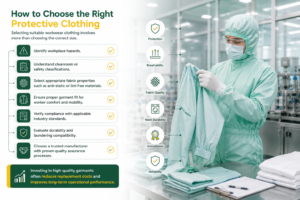 Consider the following checklist:
✔ Identify workplace hazards.
✔ Understand cleanroom or safety classifications.
✔ Select appropriate fabric properties such as anti-static or lint-free materials.
✔ Ensure proper garment fit for worker comfort and mobility.
✔ Verify compliance with applicable industry standards.
✔ Evaluate durability and laundering compatibility.
✔ Choose a trusted manufacturer with proven quality assurance processes.
Investing in high-quality garments often reduces replacement costs and improves long-term operational performance.
Maintenance and Best Practices
Proper garment maintenance is essential for maintaining protective performance.
- Follow manufacturer-recommended washing procedures.
- Store garments in clean, controlled environments.
- Inspect garments regularly for tears, damaged seams, or worn fabric.
- Replace garments that no longer meet contamination control requirements.
- Train employees on correct gowning and removal procedures.
- Avoid mixing cleanroom garments with regular laundry.
Routine inspections help extend garment life while maintaining workplace compliance.
Common Mistakes to Avoid
Organizations sometimes compromise safety by making avoidable purchasing or usage mistakes.
Common examples include:
- Choosing garments based only on price.
- Using ordinary uniforms inside cleanrooms.
- Ignoring garment replacement schedules.
- Wearing improperly fitted protective clothing.
- Failing to train employees on proper garment handling.
- Overlooking electrostatic protection in sensitive manufacturing environments.
Addressing these issues can significantly improve both safety and product quality.
Key Takeaways
Protective clothing plays a vital role in protecting employees, maintaining product integrity, and supporting regulatory compliance across multiple industries. From cleanroom garments and laboratory apparel to anti-static clothing and industrial workwear, selecting the right apparel depends on workplace hazards, contamination risks, and operational requirements.
By investing in quality protective garments and following proper maintenance practices, organizations can reduce contamination, improve efficiency, and create a safer working environment for everyone.
Expert level knowledge along with experience is required to make sure that these workwear are tailored the right way to meet and conquer the dynamic variety of challanges and requirements faced by such workwear.
Frequently Asked Questions
1. What is protective clothing?
Protective clothing consists of specialized garments designed to protect workers, products, or both from workplace hazards and contamination.
2. Is protective clothing the same as PPE?
No. PPE primarily protects workers, while cleanroom protective clothing also prevents contamination of products and controlled environments.
3. Which industries use protective workwear?
Pharmaceuticals, biotechnology, healthcare, laboratories, electronics, semiconductor manufacturing, food processing, and cleanroom facilities all rely on protective clothing.
4. Why is lint-free clothing important?
Lint-free clothing minimizes particle shedding, making it ideal for contamination-sensitive environments like pharmaceutical cleanrooms.
5. What is anti-static clothing used for?
Anti-static or ESD clothing prevents electrostatic discharge that can damage sensitive electronic components or affect manufacturing processes.
6. How often should protective garments be replaced?
Replacement depends on garment condition, laundering cycles, workplace requirements, and manufacturer recommendations.
7. What features should buyers look for?
Look for durable fabrics, proper fit, contamination control properties, compliance with relevant standards, and reliable manufacturing quality.
8. Can protective clothing improve product quality?
Yes. Proper contamination control clothing reduces the risk of particles, microorganisms, and other contaminants affecting sensitive products.
Conclusion
Suitable workwear clothing is a critical component of modern industrial safety and contamination control. Whether used in pharmaceutical manufacturing, research laboratories, healthcare facilities, or electronics production, the right garments help protect personnel, preserve product quality, and maintain compliance with industry standards.
Choosing high-quality protective workwear is not simply a purchasing decision—it is an investment in workplace safety, operational efficiency, and long-term reliability. Organizations that prioritize appropriate protective clothing are better equipped to meet stringent industry requirements while creating cleaner, safer, and more productive working environments.
