

Cleanroom Apparel: Specifications, Standards, and the Science Behind Contamination Control
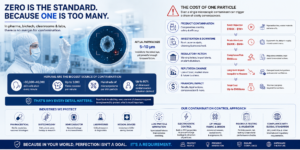
Cleanroom apparels are of utmost importance. Modern manufacturing has reached a point where a single invisible particle can destroy products worth millions of dollars. In pharmaceutical production, biotechnology research, semiconductor fabrication, and advanced medical device manufacturing, cleanroom apparel is no longer simply protective clothing—it is a precisely engineered contamination control system.
To appreciate its importance, consider one remarkable fact: a single human sheds approximately 30,000 to 40,000 skin cells every minute, even while standing still. During normal movement, that number increases dramatically. Since many of these particles carry naturally occurring microorganisms, the human body is responsible for an estimated 80% of contamination introduced into cleanrooms.
For facilities manufacturing sterile injectable medicines, implantable medical devices, or computer chips measured in nanometres, even microscopic contamination can result in rejected batches, expensive investigations, regulatory observations, or product recalls.
This is precisely why modern cleanroom apparel has evolved into a highly specialised engineering discipline.
The Hidden Enemy: Humans Are the Largest Source of Cleanroom Contamination
Contrary to popular belief, contamination rarely originates from sophisticated machinery.
It comes from people.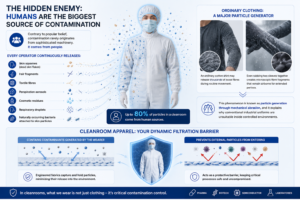
Every operator continuously releases:
- Skin squames (dead skin flakes)
- Hair fragments
- Textile fibres
- Perspiration aerosols
- Cosmetic residues
- Respiratory droplets
- Naturally occurring bacteria attached to skin particles
An ordinary cotton shirt may release thousands of loose fibres during routine movement. Even rubbing two sleeves together creates microscopic fibre fragments that remain airborne for extended periods.
This phenomenon is known as particle generation through mechanical abrasion, and it explains why conventional industrial uniforms are unsuitable inside controlled environments.
High-performance cleanroom apparel acts as a dynamic filtration barrier, containing contaminants generated by the wearer while preventing external particles from entering sensitive production zones.
Why Fabric Engineering Matters More Than Fabric Weight
Many buyers compare garments based on GSM (grams per square metre).
Professional contamination control specialists rarely do.
Instead, they evaluate properties that directly influence cleanroom performance:
Continuous Filament Construction
Unlike staple fibres found in cotton, continuous filament polyester consists of virtually endless synthetic strands.
Because there are no exposed fibre ends, particle shedding is dramatically reduced.
This seemingly minor difference is one reason continuous filament fabrics dominate pharmaceutical and semiconductor cleanrooms worldwide.
Carbon Grid Technology
If you closely examine premium cleanroom garments, you may notice a faint checkerboard pattern woven into the fabric.
Those thin dark lines are conductive carbon yarns.
Rather than making the garment electrically conductive, these fibres create controlled pathways that safely dissipate electrostatic charges generated through movement.
Without them, electrostatic discharge (ESD) can silently damage semiconductor wafers or attract airborne particles onto sterile surfaces.
Interestingly, operators often never notice electrostatic buildup because humans typically cannot feel a discharge below approximately 3,000 volts, while many electronic components may be damaged by less than 100 volts.
Seam Construction: The Detail Most Buyers Overlook
The fabric itself is only part of the contamination equation.
Garment seams often become the weakest point.
Every needle puncture creates a microscopic opening where particles may escape.
For this reason, premium cleanroom apparel frequently incorporates:
- Bound seams that encapsulate raw fabric edges
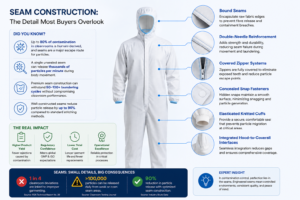
- Double-needle reinforcement
- Covered zipper systems
- Concealed snap fasteners
- Elasticated knitted cuffs
- Integrated hood-to-coverall interfaces
Some aseptic manufacturing garments even use laser-cut fabric edges to minimise fraying before stitching begins.
These construction techniques reduce particle release while significantly improving durability through repeated decontamination cycles.
Cleanroom Apparel Is Designed Around ISO Classes—Not One Universal Standard
One of the biggest misconceptions is that all cleanroom garments provide identical protection.
In reality, apparel is selected according to the cleanliness classification of the facility.
For example:
| Cleanroom Classification | Typical Industry | Apparel Requirements |
|---|---|---|
| ISO Class 8 | General pharmaceutical packaging | Basic low-lint garments |
| ISO Class 7 | Medical devices and diagnostics | Full coveralls, hoods and boot covers |
| ISO Class 5 | Sterile pharmaceutical filling | Complete aseptic garment systems with validated contamination control |
| ISO Class 3–4 | Semiconductor manufacturing | Ultra-low particle garments with advanced ESD protection |
The cleaner the environment, the greater the engineering precision required from the garment itself.
A Single Particle Can Cost Millions
One contamination event can erase months of production.
In semiconductor manufacturing, airborne particles only a fraction of a human hair’s diameter may interrupt microscopic circuitry on silicon wafafers, rendering them unusable.
Similarly, pharmaceutical manufacturers routinely reject entire batches when environmental monitoring detects microbial contamination during aseptic processing.
Such incidents do not simply represent material losses.
They may delay life-saving medicines, interrupt global supply chains, trigger regulatory investigations, and cost manufacturers millions of dollars in remediation.
Because of these risks, modern cleanroom operators receive extensive training not only on gowning procedures but also on how to move slowly, minimise unnecessary arm movements, and avoid actions that increase particle generation.
International Standards That Define High-Performance Cleanroom Apparel
Reputable manufacturers design garments to support internationally recognised contamination control systems rather than relying on marketing claims.
The most relevant standards include:
| Standard | Importance |
|---|---|
| ISO 14644 | Defines cleanroom classifications and environmental cleanliness |
| EU GMP Annex 1 | Establishes contamination control expectations for sterile medicinal manufacturing |
| ISO 13485 | Quality management for medical device manufacturing |
| ISO 9001 | Consistent quality management systems |
| EN 1149 | Electrostatic protective clothing performance |
| IEC 61340-5-1 | Electrostatic discharge control for electronics manufacturing |
While ISO 14644 classifies cleanroom environments—not garments themselves—it ultimately determines the level of cleanliness that cleanroom apparel must support.
What Separates Premium Cleanroom Apparel from Ordinary Garments?
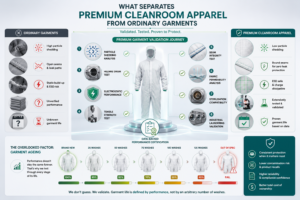
Experienced contamination control professionals evaluate far more than appearance.
High-quality garments undergo extensive validation, including:
- Particle shedding analysis
- Helmke Drum testing for airborne particle release
- Surface resistivity measurement
- Electrostatic decay testing
- Tensile strength evaluation
- Seam integrity testing
- Fabric permeability analysis
- Sterilisation compatibility studies
- Repeated industrial laundering validation
One particularly overlooked metric is garment ageing.
Repeated washing gradually alters fibre geometry, seam strength, electrostatic performance, and filtration efficiency.
Leading manufacturers therefore establish garment life using validated performance data rather than an arbitrary number of wash cycles.
The Future of Cleanroom Apparel Is Already Emerging
The next generation of cleanroom apparel extends beyond textile engineering.
Several advanced technologies are beginning to reshape contamination control:
- RFID-enabled garments that digitally track laundering history and service life.
- Smart textiles capable of monitoring electrostatic performance.
- AI-assisted garment inspection systems that identify seam defects invisible to the human eye.
- Particle mapping software that analyses contamination hotspots during operator movement.
- Sustainable reusable garments engineered to withstand hundreds of validated wash cycles while maintaining cleanroom performance.
These innovations align closely with the pharmaceutical industry’s growing emphasis on Quality Risk Management (QRM) and Contamination Control Strategy (CCS), both central principles of the revised EU GMP Annex 1 guidance.
India’s Opportunity to Lead the Global Cleanroom Apparel Industry
India already supplies a significant proportion of the world’s pharmaceutical products.
As international regulations continue to tighten, demand is shifting from low-cost garments toward scientifically validated contamination control systems.
Manufacturers investing in advanced textile engineering, independent laboratory validation, automated quality inspection, and complete material traceability will be positioned to compete globally rather than regionally.
The future belongs not to companies producing garments, but to those delivering measurable contamination control performance.

Conclusion
Today’s cleanroom apparel represents the intersection of textile science, microbiology, electrostatic engineering, ergonomics, and regulatory compliance. Every conductive fibre, bound seam, filtration property, and validated laundering process contributes to one objective: preventing contamination before it occurs.
As pharmaceutical manufacturing, biotechnology, semiconductor fabrication, and advanced research continue demanding cleaner environments than ever before, the importance of scientifically engineered cleanroom apparel will only increase. Organisations that prioritise validated performance, internationally recognised standards, and continuous innovation will remain at the forefront of contamination control—and help define the future of clean manufacturing itself.
