

Customized Lab Coat: How to Choose the Right Lab Coat for Your Team

Customized lab coat is more than a uniform. For labs, pharmaceutical companies, research facilities, hospitals, educational institutions, and manufacturing environments, the right lab coat can combine professional appearance, wearer comfort, workplace identification, and task-specific protection.
Instead of using a standard one-size-fits-all design, organizations can customize lab coats according to their requirements. Fabric, colour, length, pockets, cuffs, embroidery, branding, and sizing can all be selected based on the working environment.
For organizations with multiple employees, customized lab coats can also create a consistent professional appearance while helping distinguish departments, roles, or teams. Whether you need a White coat for lab use, a branded coat for a pharmaceutical company, or specialized workwear for a controlled environment, customization provides greater flexibility.
What Is a Customized Lab Coat?
A customized lab coat is a lab coat designed or modified according to the specific requirements of an organization, lab, institution, or individual.
Customization can include:
- Fabric selection
- Coat length
- Colour
- Collar design
- Sleeve design
- Cuff style
- Pocket configuration
- Button or snap closure
- Embroidery
- Company logo
- Employee name
- Department identification
- Size and fit
- Special functional requirements
This makes customized lab coats particularly useful for organizations that need their workwear to reflect both operational requirements and corporate identity.
The customization should, however, be based on the hazards and activities involved. Lab PPE should be selected through appropriate hazard assessment rather than appearance alone.
Why Choose a Customized Lab Coat?
A standard lab coat may be suitable for basic lab activities, but organizations often have more specific requirements.
A customized lab coat allows these requirements to be incorporated into the garment from the beginning.
1. Professional Brand Identity
A lab coat can become part of an organization’s visual identity.
Adding a company logo, employee name, or department name creates a consistent appearance across the workforce. This can be particularly useful for pharmaceutical manufacturers, diagnostic labs, hospitals, universities, research institutions, and contract manufacturing organizations.
For example, a pharmaceutical company may use its logo on the chest while adding the employee’s name and department underneath.
2. Better Identification of Employees
Customized lab coats can make it easier to identify personnel within a facility.
Different departments can use different colours, embroidery, or identification systems. For example:
- Quality Control
- Quality Assurance
- Research & Development
- Production
- Microbiology
- Analytical Lab
- Engineering
- Maintenance
This approach can make workplace identification simpler, particularly in larger facilities.
3. Improved Fit and Comfort
A lab coat needs to be comfortable enough for employees who wear it for several hours.
Customization allows organizations to specify:
- Size ranges
- Sleeve lengths
- Coat lengths
- Relaxed or tailored fits
- Cuff designs
- Pocket placement
- Fabric weight
A better fit can make routine lab work more comfortable while reducing unnecessary interference from loose or poorly positioned clothing.
4. Functional Pocket Configuration
Pockets are one of the most practical areas to customize.
Depending on the work environment, a customized lab coat can include different combinations of:
- Chest pockets
- Lower pockets
- Pen pockets
- Instrument pockets
- Internal pockets
- Mobile-device pockets
Pocket placement should be selected carefully so that the garment remains practical without creating unnecessary snagging or contamination concerns.
5. Consistent Appearance Across the Organization
For organizations ordering garments for dozens or hundreds of employees, customization creates consistency.
Instead of employees wearing different styles of lab coats, a company can establish a standardized design covering:
Colour + Fabric + Fit + Logo + Name + Department
This creates a more organized appearance across labs and production facilities.
Key Features to Consider When Customizing a Lab Coat
Choosing customization options based only on appearance can lead to an unsuitable garment. The first step should always be understanding the working environment.
1. Fabric Selection
Fabric is one of the most important decisions when designing a customized lab coat.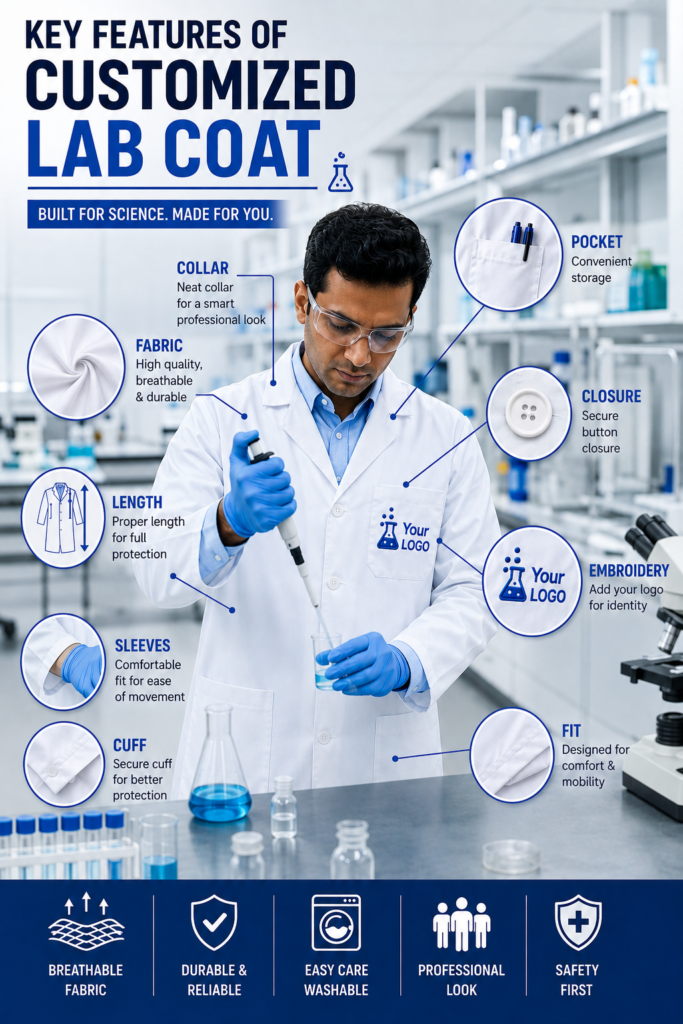
Different environments may require different fabric characteristics, such as:
- Breathability
- Durability
- Low lint generation
- Easy maintenance
- Colour retention
- Comfort
- Dimensional stability
- Static-control properties
- Resistance appropriate to the intended application
A cotton-rich fabric may be preferred in some routine lab environments because of its comfort, while blended fabrics may be selected where durability and easier maintenance are priorities.
For specialized applications, the garment specification should be matched to the actual hazards and facility requirements.
2. Length of the Coat
Lab coats are available in different lengths.
Common options include:
- Short lab coats
- Mid-length coats
- Knee-length coats
The appropriate length depends on the employee’s work and the level of coverage required.
A coat intended for routine analytical work may have different requirements from one used in a manufacturing or specialized lab environment.
3. Collar Design
The collar contributes to both appearance and functionality.
Popular options include:
- Notched collars
- Mandarin collars
- Stand collars
- Open collars
Organizations can select a design that complements their uniform system while considering the intended use of the garment.
4. Cuffs and Sleeves
Sleeves should provide sufficient coverage without interfering with lab activities.
Customization options can include:
- Standard open cuffs
- Button-adjustable cuffs
- Elasticated cuffs
- Knitted cuffs
- Adjustable sleeve openings
For specialized applications, cuff design can be particularly important because it affects how the coat interfaces with gloves and other PPE.
5. Closures
A customized lab coat can use different closure systems, including:
- Buttons
- Press studs
- Concealed snaps
- Other specified fastening systems
The choice depends on the application, desired appearance, maintenance requirements, and facility protocols.
6. Pockets
Pocket design should be based on actual employee requirements.
For example, an R&D lab may require more instrument and pen storage, while a cleanroom-related environment may have stricter requirements concerning garment design and contamination control.
Customized Lab Coat for Pharmaceutical Companies
Pharmaceutical manufacturing environments often require carefully controlled workwear systems.
Employees working in pharmaceutical facilities may operate across areas such as:
- Production
- Quality Control
- Quality Assurance
- Microbiology
- Research and Development
- Packaging
- Warehousing
- Technical services
A customized lab coat for pharmaceutical companies can therefore be designed around the specific requirements of each department.
However, customized branding should never compromise the garment’s functional requirements.
For example, embroidery, labels, trims, closures, and other additions should be evaluated according to the environment in which the garment will be used.
In controlled environments, contamination control becomes particularly important. Personnel can be a significant source of particles, fibres, microorganisms, and other contamination, making appropriate garment selection and gowning practices important parts of contamination-control programs.
Customized Lab Coats for Cleanroom Applications
Not every customized lab coat is suitable for a cleanroom.
Cleanroom applications require specialized garments designed around contamination-control requirements rather than conventional lab uniform requirements.
Depending on the cleanroom classification and process, specifications may address:
- Particle shedding
- Fabric construction
- Seam construction
- Static control
- Garment coverage
- Laundering procedures
- Packaging
- Sterilization requirements
- Material compatibility
Therefore, a standard embroidered lab coat should not automatically be considered a cleanroom garment.
The garment should be selected according to the facility’s contamination-control strategy and applicable requirements.
White Coat for Lab: Choosing the Right Design
A White coat for lab environments remains one of the most recognizable forms of professional lab apparel. The classic white colour provides a clean, professional appearance and can help establish a consistent dress code across employees.
However, choosing a white lab coat should involve more than selecting the colour.
Consider factors such as:
- Fabric quality
- Fit and sizing
- Coat length
- Sleeve construction
- Pocket arrangement
- Closure type
- Ease of washing
- Durability
- Branding requirements
- Intended work environment
For routine lab environments, a comfortable and durable white coat may be appropriate. For specialized pharmaceutical or controlled environments, the garment should be selected according to the facility’s specific requirements.
Organizations can also customize a White coat for lab use with embroidered logos, employee names, department names, or other approved identification details.
Embroidery and Branding Options
One of the most popular reasons organizations choose a customized lab coat is branding.
A professional lab coat can incorporate:
Company Logo
The organization’s logo can be embroidered on the chest or another specified location.
Employee Name
Adding an employee’s name makes identification easier and gives the garment a personalized appearance.
Department Name
Departments such as Quality Control, R&D, Microbiology, or Production can be displayed on the garment.
Colour-Coded Identification
Different colours or design elements can help distinguish departments or functions.
Institutional Branding
Universities, hospitals, research organizations, and educational institutions can incorporate their institutional identity into lab apparel.
For pharmaceutical and lab environments, branding should be implemented without creating unnecessary contamination or maintenance concerns.
Customized Lab Coat vs Standard Lab Coat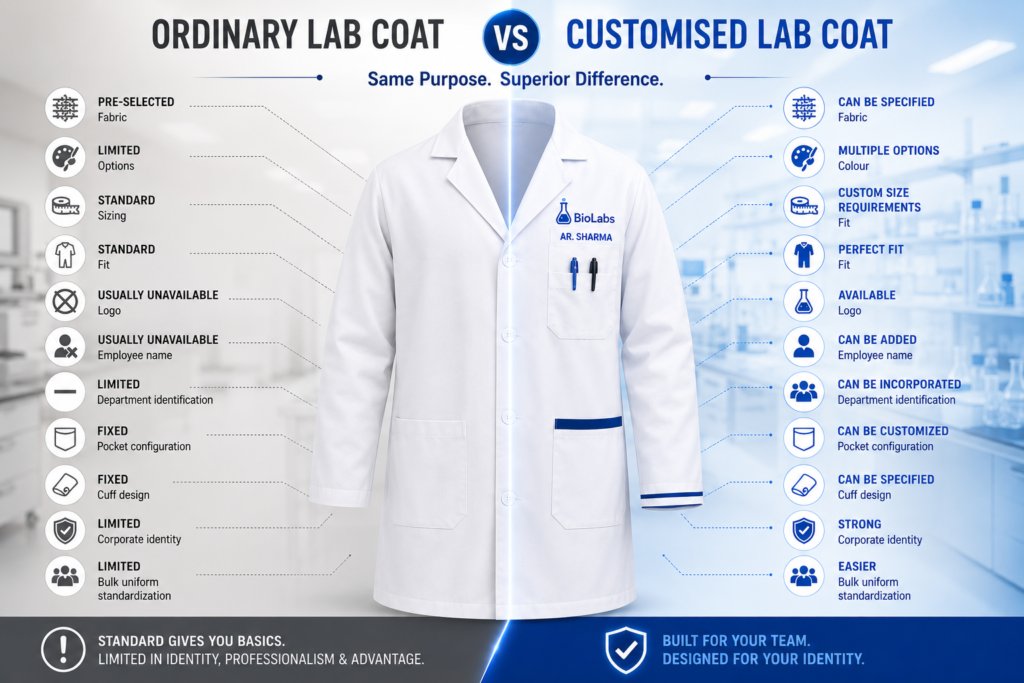
| Feature | Standard Lab Coat | Customized Lab Coat |
|---|---|---|
| Fabric | Pre-selected | Can be specified |
| Colour | Limited options | Multiple options |
| Fit | Standard sizing | Custom size requirements |
| Logo | Usually unavailable | Available |
| Employee name | Usually unavailable | Can be added |
| Department identification | Limited | Can be incorporated |
| Pocket configuration | Fixed | Can be customized |
| Cuff design | Fixed | Can be specified |
| Corporate identity | Limited | Strong |
| Bulk uniform standardization | Limited | Easier |
The key advantage of customization is control. Organizations can develop a garment specification around their workforce and working environment instead of adapting their requirements to an off-the-shelf coat.
How to Order Customized Lab Coats for Your Organization
Before placing a bulk order, prepare a clear garment specification.
Step 1: Identify the Application
Determine where the coats will be used.
Is the requirement for:
- A research lab?
- Pharmaceutical manufacturing?
- Quality control?
- Microbiology?
- A hospital?
- A university?
- A diagnostic lab?
- A cleanroom?
Step 2: Identify Workplace Hazards
Understand the substances, processes, equipment, and exposure risks involved.
The appropriate PPE should be determined through a risk assessment based on the activities employees perform.
Step 3: Select the Fabric
Choose the fabric according to the application’s performance, comfort, durability, maintenance, and contamination-control requirements.
Step 4: Finalize the Design
Specify:
- Length
- Collar
- Sleeves
- Cuffs
- Closures
- Pockets
- Colour
- Fit
Step 5: Add Branding
Finalize:
- Logo
- Employee name
- Department
- Position
- Other identification requirements
Step 6: Approve a Sample
Before ordering in bulk, review a physical sample.
Check:
- Fit
- Stitching
- Pocket position
- Logo placement
- Fabric feel
- Closure operation
- Overall appearance
Step 7: Standardize the Garment
Once the sample is approved, establish the specification for future orders. This helps maintain consistency when new employees join the organization or garments need replacement.
What Makes a Good Customized Lab Coat?
A high-quality customized lab coat should balance function, comfort, durability, appearance, and the requirements of its intended environment.
Important factors include:
Appropriate fabric → Correct fit → Functional design → Quality stitching → Practical pockets → Suitable closures → Professional branding
Customization should not simply mean adding a logo to a standard coat. The better approach is to define the garment according to the organization’s actual requirements.
Frequently Asked Questions About Customized Lab Coats
Can I add my company logo to a lab coat?
Yes. Company logos can commonly be incorporated through embroidery or other suitable identification methods. The placement and method should be selected according to the garment’s intended environment.
Can customized lab coats have employee names?
Yes. Employee names can be added alongside company or department identification.
Can lab coats be customized for pharmaceutical companies?
Yes. Pharmaceutical companies can specify garment designs based on departmental requirements, employee comfort, identification, and applicable workplace or contamination-control requirements.
Are customized lab coats suitable for cleanrooms?
Not necessarily. A customized lab coat designed for general lab use should not automatically be used in a cleanroom. Cleanroom garments need to be selected according to the facility’s contamination-control requirements.
What is the best White coat for lab use?
The best White coat for lab use depends on the working environment, required protection, fabric, fit, maintenance requirements, and workplace specifications. There is no single design that is suitable for every lab.
What fabric is best for a customized lab coat?
There is no single fabric that is best for every application. Fabric selection should consider the work being performed, required protection, comfort, durability, laundering, static-control needs, and contamination-control requirements.
Can different departments have different lab coats?
Yes. Organizations can use different colours, embroidery, department names, or other identification features to distinguish teams.
Can customized lab coats be ordered in bulk?
Yes. Bulk customization is particularly useful for pharmaceutical companies, labs, hospitals, universities, and other organizations that need standardized workwear across multiple employees.
Conclusion
A customized lab coat gives organizations greater control over how their lab apparel looks, fits, and functions. From fabric and pocket configuration to embroidery, employee identification, department branding, and sizing, almost every aspect can be planned around the organization’s requirements.
For routine lab work, customization can improve consistency and professional presentation. For pharmaceutical and specialized environments, the design should go further by considering the actual workplace hazards, contamination-control requirements, garment maintenance, and applicable standards.
A White coat for lab use can also be customized to create a consistent professional identity while meeting the practical needs of employees.
The best customized lab coat is therefore not simply the one that looks professional. It is the one designed around the people who wear it and the environment in which they work.
