
Bulk Uniform Manufacturer: Why Large-Scale Production Matters for Modern Businesses
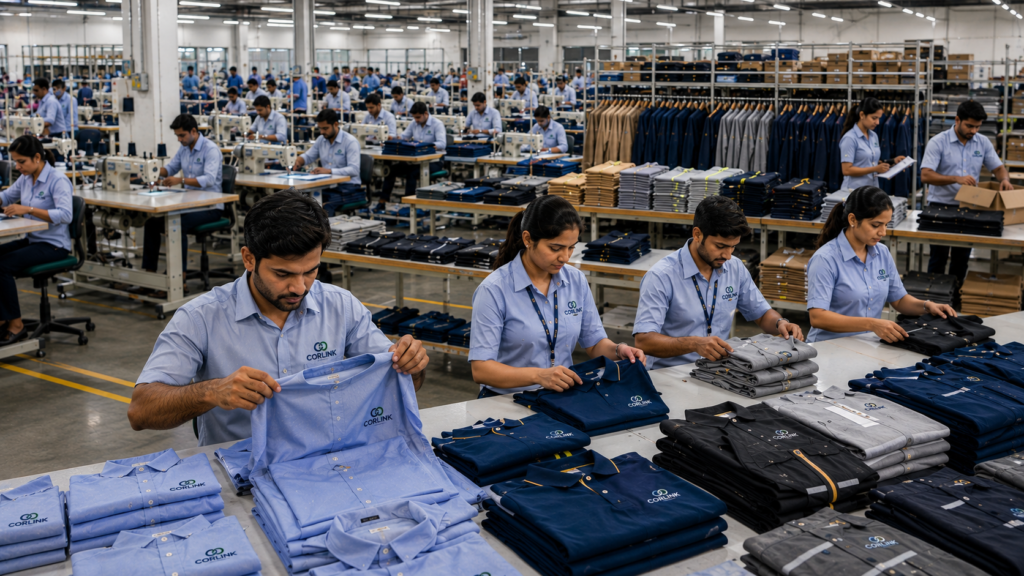
Bulk uniform manufacturer is an increasingly important search term for businesses looking to source consistent, branded and functional uniforms at scale. From corporate offices and hotels to hospitals, retail chains, schools, logistics companies and industrial facilities, organisations often need hundreds or thousands of garments that look consistent, fit properly and arrive when required.
But bulk uniform manufacturing is about much more than producing a large quantity of shirts, trousers or jackets.
A capable bulk uniform manufacturer gives businesses access to wider production capabilities, specialised fabrics, improved quality systems and changing apparel trends. That exposure ultimately helps customers build a uniform programme that is more reliable, adaptable and suitable for long-term use.
India’s textile and apparel sector provides a strong manufacturing base for this model. In FY 2025–26, India’s textile and apparel exports, including handicrafts, reached ₹3.25 lakh crore, up 1.8% from the previous year. Ready-made garments alone accounted for approximately ₹1.39 lakh crore.
For businesses purchasing uniforms in volume, this manufacturing ecosystem matters.
What Is a Bulk Uniform Manufacturer?
A bulk uniform manufacturer specialises in producing uniforms in larger quantities according to predefined designs, specifications, sizes, colours and branding requirements.
Instead of treating every garment as an individual order, bulk production creates a controlled manufacturing system.
This can include:
- Fabric sourcing
- Pattern development
- Sampling
- Size grading
- Cutting
- Stitching
- Embroidery
- Printing
- Quality inspection
- Finishing
- Packaging
- Bulk dispatch
The manufacturer may produce everything from corporate uniforms and office workwear to hospitality uniforms, industrial garments, healthcare apparel and protective clothing.
The key difference is consistency.
When a company orders 50 uniforms today and another 500 six months later, the goal is to maintain the same visual and functional standards.
Why Businesses Choose Bulk Uniform Manufacturing
Bulk purchasing is often associated with lower per-unit costs, but that is only one part of the equation.
For organisations, the bigger advantage is manufacturing consistency at scale.
Imagine a hotel opening five new properties.
It may need:
- Front-office uniforms
- Housekeeping uniforms
- Restaurant uniforms
- Kitchen apparel
- Management clothing
- Maintenance workwear
Ordering these garments individually from different suppliers can create differences in fabric, colour, sizing and finishing.
A specialised bulk uniform manufacturer can coordinate these requirements through one production system.
That makes procurement easier and helps the brand maintain a consistent appearance across locations.
Bulk Manufacturing Keeps Uniforms Connected to Industry Trends
One of the less obvious advantages of working with a bulk uniform manufacturer is exposure to what is changing across the wider apparel and textile industry.
Manufacturers serving multiple sectors see different requirements every day.
A corporate customer may ask for:
- Lighter fabrics
- Stretch garments
- Modern silhouettes
- Easy-care shirts
A hospital may require:
- Antimicrobial finishes
- Comfortable healthcare apparel
- Colour-coded garments
An industrial customer may require:
- Flame-resistant clothing
- ESD garments
- High-visibility workwear
- Durable fabrics
A hotel may prioritise:
- Premium appearance
- Breathability
- Easy maintenance
- Department-specific designs
Because manufacturers work across these requirements, they are exposed to developments in fabric technology, garment construction, production methods and workplace apparel trends.
The wider uniform industry is already moving towards more functional, durable and technically advanced garments, with technical textiles, automation, inclusive sizing and AI-supported production becoming increasingly relevant.
For the customer, this exposure can translate into better choices.
How Bulk Uniform Manufacturing Benefits the Customer
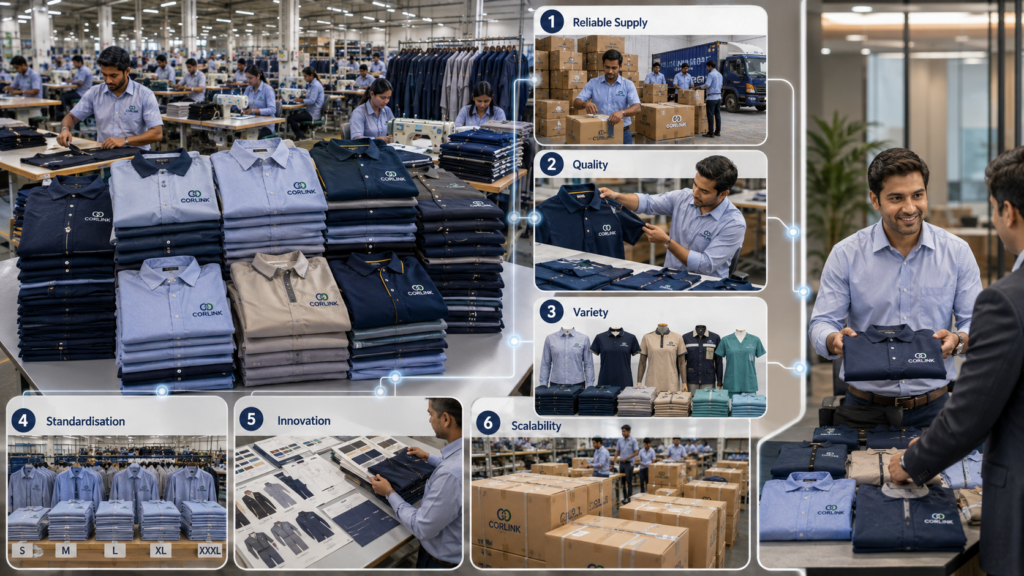
1. More Reliable Supply
Supply reliability becomes critical when uniforms are needed across multiple locations.
A company opening a new branch cannot afford to receive 60% of its uniforms on time and wait weeks for the remaining sizes.
A structured bulk manufacturing operation can plan:
Fabric → Production → Quality Control → Packaging → Dispatch
around the customer’s delivery schedule.
This becomes especially important for:
- New employee onboarding
- New branch openings
- Hotel launches
- School sessions
- Large recruitment drives
- Seasonal requirements
- Corporate events
A bulk manufacturer can also maintain production records and specifications for repeat orders, making future procurement more predictable.
Greater Consistency in Quality
Quality can become difficult to control when garments are sourced from multiple small suppliers.
You might receive:
- Different shades of the same colour
- Different fabric weights
- Uneven stitching
- Inconsistent logo placement
- Different collar construction
- Variation in sizing
A structured manufacturing process introduces checkpoints throughout production.
Quality can be assessed at stages such as:
Fabric inspection → Cutting → Stitching → Branding → Final inspection
This is particularly valuable for large organisations where hundreds of employees need to present the same professional appearance.
Better Variety Without Losing Brand Consistency
Bulk production does not necessarily mean ordering one identical shirt for everyone.
Modern organisations often need uniform systems rather than single garments.
For example, a hotel could have:
- Formal front-office uniforms
- Restaurant uniforms
- Housekeeping apparel
- Kitchen uniforms
- Maintenance workwear
All can still use the same:
- Brand colours
- Logo treatment
- Design language
- Fabric standards
This creates variety for different roles while maintaining a coherent identity.
Access to More Fabric Choices
A manufacturer working across multiple uniform categories is more likely to have experience with different fabric requirements.
Depending on the application, businesses can explore:
- Cotton
- Polyester blends
- Cotton-polyester
- Stretch fabrics
- Performance fabrics
- Moisture-management fabrics
- Easy-care fabrics
- Technical textiles
- Flame-resistant materials
- Antistatic fabrics
The right selection depends on the employee’s environment and responsibilities.
A receptionist in an air-conditioned office does not have the same requirements as a technician working outdoors or an operator entering an industrial production area.
Bulk Orders Encourage Better Standardisation
Large orders require specifications to be clearly defined.
A professional manufacturer may establish:
- Approved fabric
- Pantone or colour reference
- Stitching specifications
- Logo size
- Embroidery location
- Button type
- Collar construction
- Size chart
- Garment measurements
- Packaging requirements
Once these specifications are approved, they become a reference for future production.
This helps prevent the familiar problem of a uniform gradually changing every time a company places a new order.
Innovation Becomes More Accessible
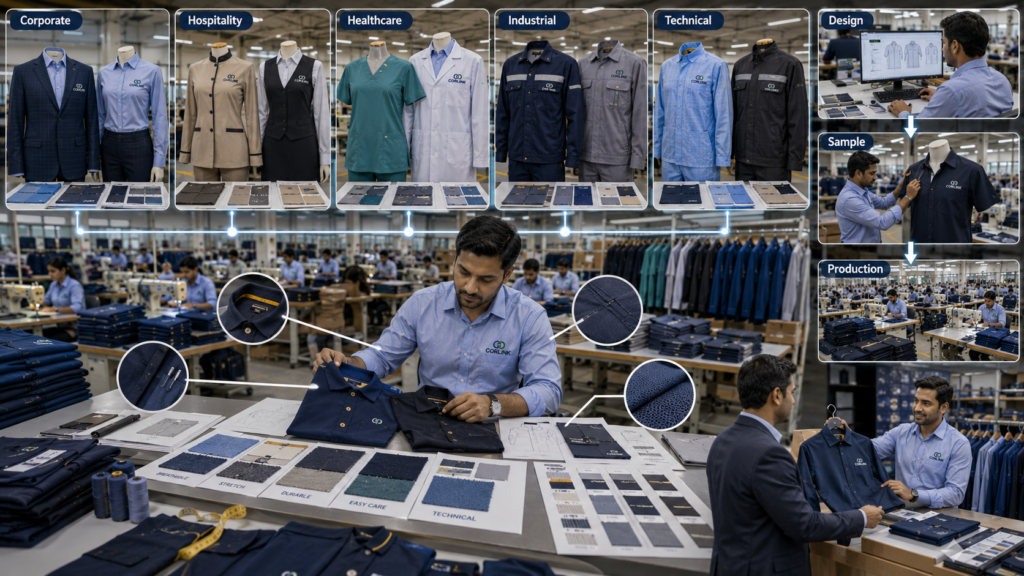
Innovation in uniforms does not always mean introducing something futuristic.
Sometimes it is a simple improvement that makes an employee’s working day easier.
For example:
A field employee may benefit from a stretch fabric that allows easier movement.
A hotel employee may benefit from a breathable, easy-care fabric.
A technician may require reinforced pockets.
An industrial worker may require ESD or protective clothing.
A healthcare worker may need a garment designed around repeated washing and long working hours.
Because bulk manufacturers are exposed to different applications, they can bring these ideas into new projects.
Bulk Uniform Manufacturer vs Local Tailor
For a small requirement, a local tailor may be perfectly suitable.
But the requirements change when an organisation needs 500, 2,000 or 10,000 uniforms.
| Requirement | Local Tailor | Bulk Manufacturer |
|---|---|---|
| Small custom order | Strong | Possible |
| Large quantities | Limited | Strong |
| Standardised sizing | Variable | Structured |
| Repeat production | Variable | Easier |
| Fabric sourcing | Limited | Wider options |
| Quality control | Basic to moderate | Multi-stage |
| Branding | Usually available | Integrated |
| Multi-location supply | Difficult | More scalable |
| Role-specific designs | Possible | Strong |
| Production planning | Limited | Structured |
The right choice ultimately depends on order size, complexity and business requirements.
How Bulk Uniform Manufacturing Supports Growing Companies
Growth creates a new uniform problem.
A company with 50 employees can manage clothing requirements relatively easily.
A company with 2,000 employees across 10 cities needs something much more systematic.
The business may need:
Centralised specifications + regional distribution + repeat production + size management
This is where a bulk uniform manufacturer becomes valuable.
Instead of repeatedly explaining the same requirements, the customer can maintain an approved uniform specification and reorder according to workforce requirements.
This can make uniform procurement considerably easier as the organisation expands.
Bulk Manufacturing Is Particularly Useful for Multi-Location Businesses
Consider a restaurant chain operating across India.
The organisation wants its employees to look consistent whether they work in:
- Delhi
- Mumbai
- Bengaluru
- Hyderabad
- Chennai
The uniforms may need to account for regional climate differences while maintaining the same brand identity.
A bulk manufacturer can produce a common uniform programme while allowing practical modifications where required.
For example:
Same branding + same colour system + same quality standard + climate-appropriate fabric choices
That balance is difficult to achieve through fragmented sourcing.
Quality Should Come Before Quantity
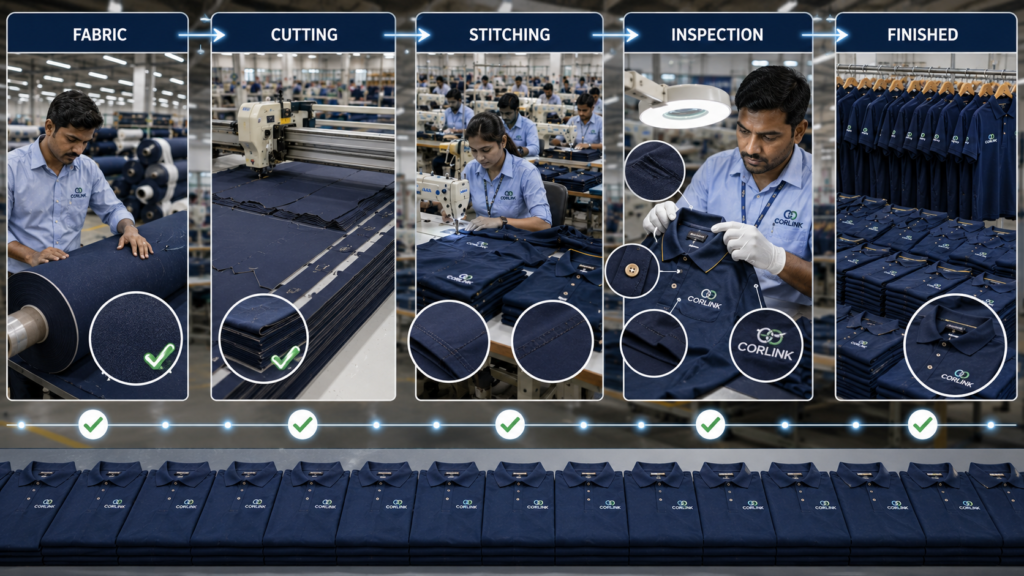
A large order is only valuable if the garments are actually usable.
Before selecting a bulk uniform manufacturer, businesses should evaluate:
Fabric Quality
Check weight, composition, colourfastness and suitability for the working environment.
Stitching
Look at seams, hems, collars, cuffs and stress points.
Size Consistency
Compare measurements across multiple samples.
Branding
Check embroidery or printing for accuracy and durability.
Wash Performance
Test garments after repeated washing.
Sample Approval
Never move directly into large-scale production without approving representative samples.
Production Capacity
Confirm that the manufacturer can handle the required quantity within the expected timeline.
A Good Bulk Uniform Manufacturer Should Offer More Than Production
Manufacturing capability is important, but customer support matters too.
A strong supplier should ideally help with:
- Design development
- Fabric selection
- Sampling
- Size grading
- Branding
- Production planning
- Quality control
- Packaging
- Repeat orders
- Delivery coordination
This turns the relationship from a simple buyer-seller transaction into a longer-term supply partnership.
Uniforms Are Becoming More Technical which Keeps a Bulk Uniform Manufacturer upto Date
The modern uniform industry is moving beyond basic shirts and trousers.
Across healthcare, hospitality, manufacturing, aviation, logistics and corporate services, uniforms increasingly need to balance appearance, comfort, safety and performance.
This creates demand for specialised categories such as:
- Industrial workwear
- Cleanroom apparel
- ESD garments
- Protective clothing
- White Coat for Lab
- Healthcare uniforms
- Hospitality uniforms
- Corporate workwear
- High-visibility clothing
- Performance uniforms
For businesses, this means the right bulk uniform manufacturer can provide much more than standard corporate clothing.
What to Ask Before Choosing a Bulk Uniform Manufacturer
Before placing a large order, ask:
Can you provide samples?
A sample gives you an opportunity to test fit, comfort, fabric and construction.
What is your production capacity as a bulk uniform manufacturer?
A supplier should have enough capacity for your order without compromising timelines.
Can you reproduce the same design later?
This is critical for repeat orders.
What fabrics are available?
Ask for options appropriate to your climate and employee activity.
How is quality checked?
Understand whether inspection happens only at the end or throughout production.
Can you handle multiple garment styles?
Useful for businesses with different departments.
Can you manage branding?
Ask about embroidery, printing, labels and packaging.
What happens when sizes are missing?
A clear replacement and alteration process can prevent problems later.
The Future of Bulk Uniform Manufacturer Business in India
India’s apparel manufacturing ecosystem is evolving alongside technology and changing customer expectations.
Recent industry discussions around textile manufacturing have highlighted the growing role of AI, automation and data-driven decision-making in helping manufacturers respond more quickly to changing demand.
At the same time, India’s textile and apparel exports reached ₹3.25 lakh crore in FY 2025–26, showing the scale and continuing international relevance of the country’s manufacturing ecosystem.
For bulk uniform buyers, this evolution matters.
It can mean:
- More fabric choices
- Better production planning
- More accurate sizing
- Improved quality control
- Faster product development
- More functional garments
- Better repeat-order consistency
- Greater customisation
The future of bulk uniform manufacturing is therefore not simply about making more garments.
It is about making better garments at scale.
Conclusion
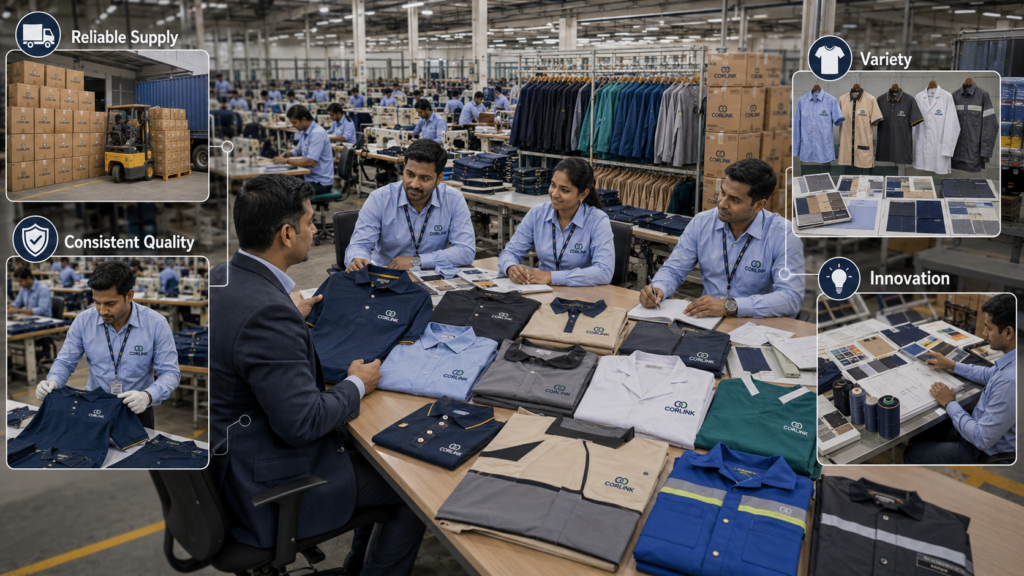
A bulk uniform manufacturer can play a much larger role in a business’s apparel strategy than simply fulfilling a large purchase order.
Large-scale production gives manufacturers exposure to multiple industries, changing workplace requirements, new fabrics, evolving designs and emerging production technologies. That experience can flow back to customers in the form of more dependable supply, consistent quality, broader product choices and better-informed design decisions.
For a growing company, this matters.
The uniform worn by an employee represents the organisation every working day. It needs to look right, feel comfortable, withstand repeated use and remain available when the business needs additional quantities.
Whether the requirement is for corporate uniforms, office workwear, industrial garments, protective clothing, cleanroom apparel or specialised staff uniforms, choosing a manufacturer with genuine bulk-production capability can make the entire procurement process more resilient.
The best bulk uniform partnership is therefore not simply about finding the lowest price per piece.
It is about finding a manufacturing partner capable of delivering consistency today while keeping the uniform programme ready for tomorrow.
Frequently Asked Questions for Bulk Uniform Manufacturer
What is a bulk uniform manufacturer?
A bulk uniform manufacturer produces large quantities of customised uniforms according to defined specifications for businesses, institutions and organisations.
What are the benefits of buying uniforms in bulk?
Bulk procurement can provide greater consistency, easier standardisation, better production planning and potentially more competitive unit economics.
Can a bulk uniform manufacturer customise uniforms?
Yes. Depending on the manufacturer, customisation can include garment design, fabric, colours, embroidery, printing, labels, trims and sizing.
What industries use bulk uniforms?
Corporate offices, hospitality, healthcare, education, retail, manufacturing, logistics, aviation, construction and facility management are among the sectors that commonly require uniforms at scale.
How do I choose a bulk uniform manufacturer?
Evaluate samples, fabric quality, production capacity, quality-control procedures, sizing consistency, branding capabilities, delivery timelines and the manufacturer’s ability to support repeat orders.
Can bulk uniform manufacturers provide specialised workwear?
Yes. Many manufacturers handle specialised categories such as industrial workwear, protective clothing, ESD garments, cleanroom apparel, lab coats and performance uniforms, depending on their production capabilities.