Staff Uniform: The Psychological, Commercial and Organisational Advantages for Modern Businesses
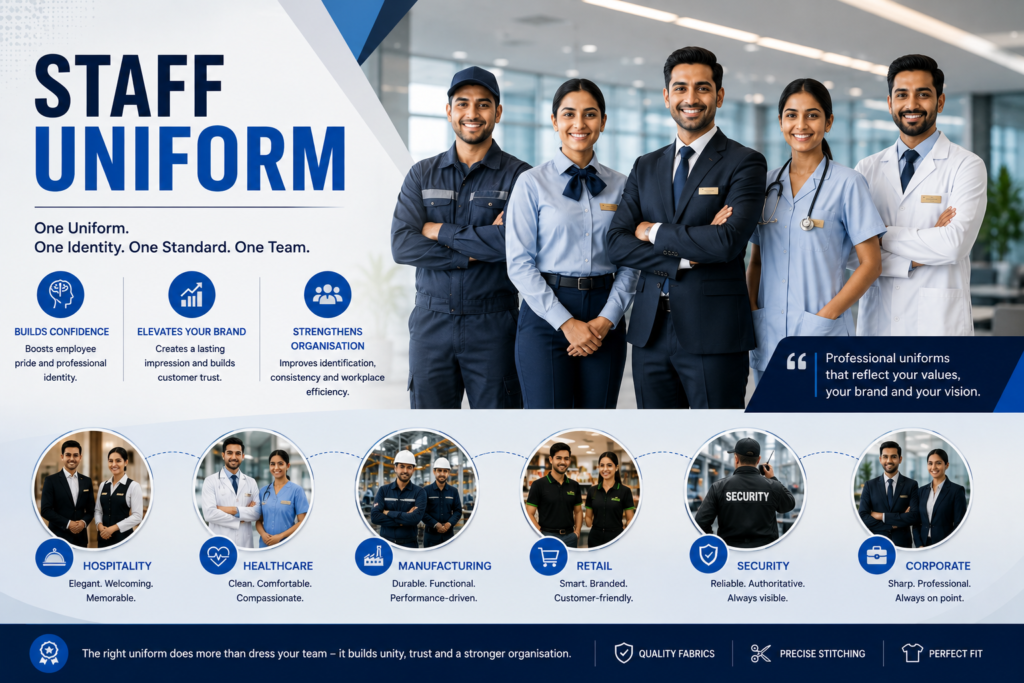
Staff uniform is more than a dress code. When designed correctly, it can influence how employees feel about their roles, how customers perceive a business and how consistently an organisation presents itself.
From a hotel receptionist and hospital nurse to a pharmaceutical production operator or retail salesperson, what employees wear can communicate identity, professionalism, authority and belonging before a single word is spoken.
Research supports this idea. A study published in the Journal of Applied Social Psychology found that uniforms make employees’ connection with their organisation more visually salient and can influence how customers attribute service experiences to the company.
But there is an important qualification: a uniform only creates these advantages when it is functional, comfortable and appropriate for the job. Poorly designed uniforms can negatively affect employee attitudes and customer perceptions.
So, what makes a good staff uniform valuable to an organisation?
What Is a Staff Uniform?
A staff uniform is coordinated workwear provided or specified by an organisation for employees to create a consistent appearance.
Depending on the industry, a staff uniform can include:
- Shirts and trousers
- Polo shirts
- Blazers
- Scrubs
- Lab coats
- Industrial garments
- Hospitality uniforms
- Security uniforms
- Housekeeping uniforms
- Corporate uniforms
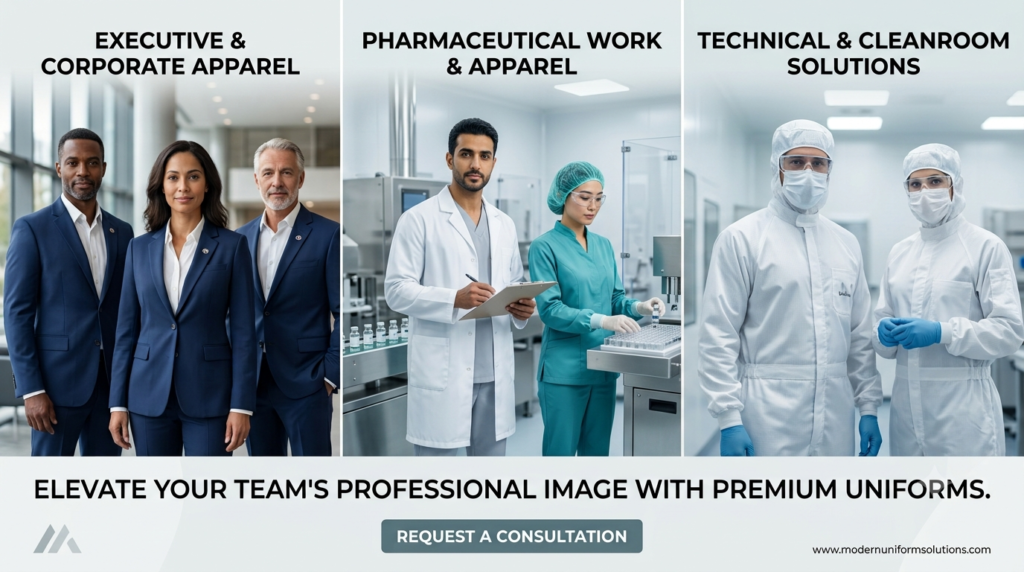
- Pharmaceutical garments
- Cleanroom apparel
- Safety clothing
The design should reflect the employee’s role.
A hotel receptionist may need an elegant, branded appearance, while a pharmaceutical production operator may require technically specified workwear. A hospital nurse needs freedom of movement and easy-care fabric, while a warehouse employee may need durable garments designed for physical activity.
Uniformity does not mean making every employee wear exactly the same garment. It means creating a consistent visual system appropriate to different roles.
Why Does Staff Uniform Matter?
A well-designed staff uniform can deliver benefits across three major areas:
🧠 Psychological
It can influence employee confidence, belonging and professional identity.
💼 Commercial
It can improve brand visibility, customer recognition and perceptions of professionalism.
⚙️ Organisational
It can make employees easier to identify, support role differentiation and create a consistent workplace standard.
Think of it as:
Employee → Organisation → Customer
A good uniform connects all three.
Staff Uniform Can Strengthen Employee Identity
One of the strongest psychological advantages of a uniform is its ability to communicate “I belong here.”
When employees wear clothing associated with their organisation, their individual appearance becomes connected to a larger group identity.
Research by Smith, Chandler and Schwarz found that uniforms increase the extent to which customers mentally categorise employees as members of the organisation.
This matters particularly in large organisations.
Imagine walking into a hospital with 1,000 employees.
Without a visual system, identifying roles can be difficult.
With clearly differentiated uniforms, customers can quickly distinguish:
Doctor → Nurse → Technician → Housekeeping → Security → Administration
The uniform becomes an instant organisational signal.
Uniforms Can Increase Employee Confidence
Clothing can influence how people perceive themselves.
A study of 201 employees at Las Vegas casino-resorts found a significant relationship between uniform design and employee attitudes. The research reported that certain uniform characteristics could increase employees’ self-confidence and perceived credibility.
This provides an important lesson for employers:
Don’t design uniforms only for the customer.
The employee wearing the uniform is equally important.
A stylish uniform that looks good but restricts movement may create frustration.
A practical uniform that fits properly, feels comfortable and looks professional can help employees feel more prepared for their role.
Staff Uniform Creates a Sense of Team

Consider two teams working in the same office.
Team A
Everyone arrives wearing completely different clothing with no visual connection.
Team B
Employees wear coordinated shirts or jackets featuring the company’s colours and branding.
Team B immediately looks more cohesive.
That visual similarity can reinforce the idea that employees are part of the same organisation.
This is particularly useful for:
- Retail teams
- Hotels
- Restaurants
- Hospitals
- Airlines
- Security companies
- Facility-management teams
- Delivery businesses
- Manufacturing companies
A uniform can therefore act as a visual representation of organisational culture.
It Can Make Employees Easier for Customers to Identify
This is one of the simplest commercial benefits of a staff uniform.
Imagine entering a large electronics store and needing help.
You don’t want to ask ten customers:
“Do you work here?”
A clearly branded uniform immediately answers the question.
The same principle applies to:
- Hotels
- Airports
- Hospitals
- Supermarkets
- Banks
- Restaurants
- Service centres
- Department stores
- Events
A customer can identify the employee responsible for helping them without additional signage.
This can make customer interactions more efficient.
Staff Uniform Turns Employees Into Brand Ambassadors
Your employees interact with customers in places where your advertising may never appear.
A branded uniform can extend the visibility of the company beyond its physical premises.
Consider a technician wearing a branded uniform while travelling between customer locations.
The company’s:
Logo + Colours + Name + Employee
are visible in the real world.
This creates repeated brand exposure without requiring another billboard, poster or digital advertisement.
For businesses with mobile teams, this can be particularly valuable.
Examples include:
- HVAC companies
- Telecom technicians
- Security agencies
- Home healthcare providers
- Pest-control companies
- Delivery services
- Maintenance contractors
- Field-service companies
The uniform effectively becomes mobile brand communication.
Staff Uniform Can Influence Customer Perception
Customers don’t evaluate businesses based solely on products and prices.
They also interpret visual signals.
Research published in the Asia Pacific Journal of Tourism Research found significant relationships between employee uniform styles, employee perceptions of job performance, job satisfaction and customers’ perceptions of employee performance.
Another study found that uniforms can make customers attribute service experiences more strongly to the organisation itself. In other words, when an employee is visibly associated with a company, customers may see that employee’s behaviour as more representative of the organisation.
This creates an important business lesson:
A uniform increases visibility, but it also increases accountability.
If the employee delivers excellent service, the uniform can strengthen the positive association with the brand.
If the employee behaves poorly, the organisation may also receive more of the blame.
A Uniform Strengthens Professionalism
Walk into a five-star hotel.
You will often see coordinated uniforms across:
- Reception
- Concierge
- Housekeeping
- Restaurant
- Security
- Maintenance
Now imagine the same employees dressed without any coordinated visual identity.
The service may be identical, but the perceived organisation can feel very different.
This is because uniforms provide a visual structure.
They communicate:
“These people work together, and they represent the same organisation.”
This is particularly important in service businesses where customers cannot physically evaluate the quality of the service before purchasing it.
Staff Uniform Improves Role Recognition
Uniforms don’t necessarily have to look identical.
A better approach for large organisations is often role-based uniform design.
For example, a hospital could use:
| Role | Uniform |
|---|---|
| Doctor | White coat or professional medical attire |
| Nurse | Colour-coded scrubs |
| Lab Technician | Lab coat or technical uniform |
| Housekeeping | Dedicated housekeeping uniform |
| Security | Security uniform |
| Administration | Corporate attire |
The visual differences help employees and customers understand organisational roles.
This becomes particularly useful in environments where people need assistance quickly.
Staff Uniform Supports Workplace Organisation
A uniform policy can also simplify day-to-day management.
Instead of employees deciding what is appropriate to wear every morning, the organisation establishes a clear standard.
This can reduce ambiguity around:
- Dress expectations
- Branding
- Employee identification
- Department differentiation
- Customer-facing appearance
- Workplace presentation
For a company with hundreds of employees, that consistency can be valuable.
It also makes onboarding easier.
A new employee receives:
Uniform → Name badge → Department identification → Appearance guidelines
rather than trying to interpret an informal dress code.
Staff Uniform Supports Safety and Hygiene
Not every uniform is purely cosmetic.
In many industries, workwear has a functional purpose.
Healthcare
Scrubs and medical coats can support professional identification and hygiene procedures.
Manufacturing
Industrial uniforms can be designed for durability and workplace requirements.
Pharmaceuticals
Specialized garments can support site-specific hygiene and gowning procedures.
Food processing
Protective clothing can support hygiene controls.
Construction
High-visibility and protective garments can improve worker visibility when required.
Cleanrooms
Specialized apparel can be selected to support contamination-control requirements.
Therefore, the best staff uniform combines:
Branding + Comfort + Function + Safety
rather than focusing exclusively on appearance.
A Good Staff Uniform Reduces Visual Inequality
Workplaces contain people from different backgrounds, age groups and personal styles.
A coordinated uniform can create a common visual baseline.
Employees are no longer required to compete through personal clothing choices.
Everyone represents the organisation using the same visual language.
This does not mean uniforms should suppress individuality. Modern organisations can offer:
- Multiple fits
- Gender-inclusive options
- Different cuts
- Multiple sizes
- Seasonal variations
- Role-specific designs
The goal should be consistency without unnecessary restriction.
Comfortable Staff Uniform Influences Job Satisfaction
The word comfortable should never be treated as a minor specification.
Employees may wear their uniforms for eight, ten or even twelve hours.
Poor fabric selection can result in:
- Excessive heat
- Restricted movement
- Skin discomfort
- Poor breathability
- Excessive weight
- Difficult maintenance
Research on hospitality employees found a significant relationship between uniform design and employee attitudes. The researchers also concluded that managers should involve employees in uniform selection.
This is an important procurement lesson:
Don’t simply ask:
“Does management like the uniform?”
Also ask:
“Can employees comfortably wear it for an entire shift?”
Staff Uniform Improves Brand Consistency
A company’s branding normally includes:
Logo + Colours + Typography + Packaging + Website + Advertising
But there is one branding element businesses sometimes overlook:
People.
Employees are often the most visible part of a service business.
A coordinated staff uniform extends the company’s visual identity into:
- Stores
- Offices
- Hotels
- Hospitals
- Events
- Customer locations
- Transport vehicles
- Trade exhibitions
This makes the uniform an important part of physical brand identity.
Staff Uniform: Airlines
Airlines provide one of the clearest examples of uniform-based brand identity.
Think about walking through an airport.
Before seeing an employee’s name badge, you can often recognise the airline from:
- Uniform colours
- Silhouette
- Accessories
- Branding
- Grooming standards
The uniform helps transform an otherwise ordinary employee into a recognisable representative of the airline.
This is particularly important in airports because passengers are often:
rushed + unfamiliar with the environment + looking for assistance.
Instant employee recognition therefore has practical value.
Staff Uniform: Hospitals
Hospitals demonstrate another important advantage.
A patient or visitor may encounter dozens of employees during a single visit.
A well-designed uniform system can make it easier to distinguish:
Clinical staff → Support staff → Technical staff → Administration
This can reduce confusion and make it easier for visitors to identify the right person.
In a stressful environment such as a hospital, that seemingly small advantage can improve the overall experience.
Staff Uniform: Hotels
Hotels depend heavily on customer experience.
Research on hotel employees has repeatedly examined the relationship between uniforms, employee attitudes and customer perceptions. One study specifically found relationships between uniform design, employee job performance perceptions and hotel image.
Consider the difference between:
Receptionist in coordinated professional attire
and
Receptionist wearing unrelated casual clothing.
The service could be identical.
But the uniform provides a visual cue that says:
“This person represents the hotel.”
That distinction matters in a premium hospitality environment.
The Organisational Advantage: One Standard Across Multiple Locations
Uniform programmes become particularly valuable when a company operates across several branches.
Imagine a healthcare company with:
20 hospitals + 50 diagnostic centres + 2,000 employees
Without standardisation, each location may gradually develop its own appearance.
A centralised uniform programme can establish:
- Approved fabrics
- Standard colours
- Logo placement
- Department identification
- Size specifications
- Garment construction
- Replacement schedules
The result is a more consistent organisation.
But Uniforms Can Backfire
This is an important point that businesses should not ignore.
Uniforms aren’t automatically beneficial.
The research on employee uniforms also identifies potential negative effects.
The 201-employee hospitality study found that some uniform designs could negatively affect employee experiences, including situations where employees received unwanted comments from guests.
More recent research on uniforms and service work also highlights how uniforms can influence work identity and interactions, while potentially becoming a form of organisational control if employee needs are not adequately considered.
So the objective should never be:
“Make everyone look identical.”
The better objective is:
“Create a professional, functional and inclusive visual identity.”
How to Design an Effective Staff Uniform
A strong uniform programme should balance five factors.
1. Employee Comfort
Can the employee wear it for a full shift?
2. Functional Performance
Does it suit the job?
3. Brand Identity
Does it reflect the organisation?
4. Customer Experience
Can customers identify employees easily?
5. Organisational Consistency
Can the design be reproduced across locations and future orders?
Think of it as:
Comfort × Function × Brand × Consistency = Effective Staff Uniform
What Fabric Should You Choose?
Fabric selection should depend on the workplace.
Cotton
Good breathability and comfort.
Poly-Cotton
A practical balance of comfort and durability.
Polyester
Useful where durability and dimensional stability are priorities.
Technical Fabrics
Suitable for specialised applications requiring properties such as low-lint performance, electrostatic control or other technical characteristics.
For a hospitality employee, comfort may be the priority.
For a pharmaceutical operator, technical performance may be more important.
For a field technician, durability may dominate.
There is no universal best uniform fabric.
The best fabric is the one that matches the job.
How Businesses Can Measure the Value of Staff Uniforms
A company should not evaluate uniforms only by their purchase price.
Consider:
Employee metrics
- Employee satisfaction
- Comfort feedback
- Uniform acceptance
- Replacement frequency
Customer metrics
- Ease of employee identification
- Customer feedback
- Perceived professionalism
- Brand recognition
Operational metrics
- Uniform durability
- Laundry performance
- Replacement cost
- Inventory requirements
- Standardisation across branches
This turns uniform procurement from a simple purchasing exercise into a measurable organisational programme.
A Practical Staff Uniform Checklist
Before placing an order, businesses should evaluate:
- Employee role
- Working environment
- Shift duration
- Fabric composition
- GSM
- Breathability
- Durability
- Size range
- Fit
- Pocket requirements
- Logo placement
- Department identification
- Colour coding
- Washing requirements
- Seasonal requirements
- Replacement policy
- Employee feedback
- Quality inspection
- Repeat-order consistency
A sample should ideally be tested by actual employees before large-scale production.
Staff Uniform Is a Business Tool, Not Just Clothing

The strongest organisations understand that uniforms operate at several levels simultaneously.
Psychologically
They can support identity, confidence and belonging.
Commercially
They can strengthen brand visibility and influence customer perceptions.
Organisationally
They can improve role recognition, consistency and workplace standards.
But the most important lesson from the research is that design matters.
A uniform that looks impressive but is uncomfortable can damage employee acceptance.
A comfortable uniform with poor branding can weaken visual consistency.
A highly branded uniform that is inappropriate for the job can undermine professionalism.
The solution is to design around the employee first, then integrate the brand.
Conclusion
Staff uniform can become a powerful part of an organisation’s identity when it is designed as more than a dress code.
Research has shown relationships between uniform design, employee attitudes, confidence, perceived performance and customer perceptions. Research also shows that uniforms make employees more strongly associated with their organisations, meaning both positive and negative service experiences can have a stronger effect on company perceptions.
The commercial opportunity is therefore clear: a uniform can put the brand directly in front of customers.
The organisational opportunity is equally important: a well-designed uniform can help employees identify roles, create consistency and strengthen the feeling of being part of one team.
And psychologically, the right uniform can help employees feel prepared, confident and connected to their organisation.
The key word, however, is right.
The best staff uniform is not necessarily the most expensive or fashionable one. It is the one that combines:
Professional appearance + Employee comfort + Functional performance + Brand identity + Organisational consistency.
When those elements come together, a staff uniform stops being simply something employees wear.
It becomes part of how the organisation works, looks and is remembered.
Frequently Asked Questions
What are the main benefits of a staff uniform?
The main benefits include stronger brand visibility, easier employee identification, improved organisational consistency, professional presentation, role recognition and potential benefits to employee confidence and workplace identity.
Does a staff uniform improve employee performance?
Uniforms should not be treated as a guaranteed productivity tool. However, research has found relationships between uniform design, employee attitudes and perceived job performance. The design, comfort and suitability of the uniform are important factors.
Can staff uniforms improve customer trust?
Uniforms can influence how customers categorise employees and their relationship with the organisation. Research has found that uniforms affect customer judgments and how responsibility for service experiences is attributed to the company.
Should employees be involved in choosing uniforms?
Yes. Employee feedback can help identify problems with comfort, fit, movement and practicality. Research on hospitality uniforms specifically recommends involving employees in uniform selection.
What industries use staff uniforms?
Healthcare, hospitality, retail, manufacturing, pharmaceuticals, logistics, aviation, security, education, facility management, construction and many service industries use staff uniforms.
