

Uniform Manufacturers in Hyderabad: Choosing the Right Workwear for Healthcare, Pharma and Industry

Uniform manufacturers in Hyderabad are increasingly serving a diverse industrial ecosystem that includes pharmaceutical companies, hospitals, biotechnology firms, medical-device manufacturers, diagnostic centres, research institutions and general manufacturing businesses.
Hyderabad has developed into one of India’s most important centres for pharmaceuticals, biotechnology, medical devices, healthcare, research and advanced manufacturing. This expanding industrial ecosystem has also created a growing requirement for professionally designed uniforms, industrial garments, lab coats, cleanroom apparel, healthcare workwear and customized employee clothing.
For businesses searching for uniform manufacturers in Hyderabad, the decision should go beyond fabric colour and stitching. The right uniform needs to match the working environment, employee responsibilities, safety requirements, branding guidelines and frequency of use.
From a pharmaceutical unit in Genome Valley to a hospital in Banjara Hills, a medical-device manufacturer in Sultanpur or an industrial facility around Shamshabad and Rangareddy, uniform requirements can be completely different.
This guide explains what businesses should consider when selecting a uniform manufacturer in Hyderabad and why the city’s rapidly expanding medical and life-sciences ecosystem is creating new opportunities for specialized workwear.
Why Is Hyderabad Important for the Medical and Life-Sciences Industry?

Hyderabad is not only a major healthcare destination. It has developed a broad life-sciences ecosystem covering pharmaceutical manufacturing, vaccines, biotechnology, medical devices, diagnostics, clinical research and healthcare technology.
According to Invest Telangana, the state has more than 2,000 life-sciences companies and over 269 USFDA-approved manufacturing facilities, while Hyderabad is positioned as a major life-sciences hub. The state also identifies Genome Valley, the Medical Devices Park and Green Pharma City as important components of this ecosystem. (Invest Telangana)
This matters for the uniform manufacturing industry because each of these sectors creates different apparel requirements.
Think about the difference:
| Industry | Typical uniform requirement |
|---|---|
| Pharmaceutical manufacturing | Industrial uniforms, lab coats, cleanroom garments |
| Hospitals | Doctor coats, nursing uniforms, housekeeping uniforms |
| Diagnostic centres | Lab coats, scrubs, technician uniforms |
| Medical-device manufacturing | ESD apparel, cleanroom garments, industrial workwear |
| Biotechnology | Lab coats, low-lint apparel, controlled-environment garments |
| Universities | Lab coats, department uniforms, institutional workwear |
| Food & healthcare manufacturing | Hygienic uniforms, caps, coats and protective apparel |
This makes Hyderabad an interesting market for manufacturers that can provide application-specific uniforms rather than one standard garment for every customer.
Hyderabad’s Pharmaceutical Industry Creates a Strong Uniform Market
Hyderabad’s pharmaceutical industry is one of the city’s biggest industrial strengths.
Telangana’s government describes the state as one of India’s leading pharmaceutical and life-sciences manufacturing hubs, with the sector contributing a significant share of India’s pharmaceutical production. The ecosystem includes pharmaceutical companies, vaccine manufacturers, biotechnology companies, contract research organizations and supporting industries. (Invest Telangana)
The Genome Valley cluster is particularly important. According to Invest Telangana, it spans approximately 1,000 acres and houses more than 200 biotechnology and pharmaceutical companies from 18 countries. It also includes major vaccine manufacturers and contract research organizations. (Invest Telangana)
What does this mean for uniforms?
A pharmaceutical manufacturing facility may require several different categories of apparel:
- Production uniforms
- Lab coats
- QC uniforms
- QA uniforms
- Cleanroom garments
- Visitor coats
- ESD garments
- Shoe covers
- Head covers
- Disposable protective apparel
- Housekeeping uniforms
- Security and facility-management uniforms
The requirement becomes even more specialized when employees enter controlled manufacturing areas.
Genome Valley and the Demand for Technical Apparel
Genome Valley is one of Hyderabad’s most important life-sciences clusters.
The ecosystem brings together pharmaceutical companies, biotechnology firms, research organizations, contract research companies and supporting businesses. Invest Telangana reports that the cluster provides employment to more than 15,000 skilled professionals and has a significant concentration of research and manufacturing activity. (Invest Telangana)
For uniform manufacturers, this creates an important distinction.
A researcher working in an R&D facility does not necessarily need the same apparel as a production operator working inside a pharmaceutical manufacturing area.
R&D environment
A research professional may require:
- Comfortable lab coat
- Functional pockets
- Durable fabric
- Easy laundering
- Professional appearance
Controlled production environment
A production operator may require:
- Low-lint garment
- Appropriate closure system
- Covered seams
- Controlled accessories
- Cleanroom-compatible construction
- Specific gowning procedures
Understanding this difference is what separates a technical uniform manufacturer from a conventional uniform supplier.
Medical Devices Are Creating Another Uniform Opportunity
Hyderabad’s medical industry extends beyond pharmaceuticals.
The city is also developing a significant medical-device manufacturing ecosystem.
The Medical Devices Park at Sultanpur is described by Invest Telangana as India’s largest dedicated medical-device manufacturing and R&D facility. The park covers approximately 302 acres and houses more than 55 companies, with applications ranging from stents and diagnostic kits to ophthalmic devices, orthopedic implants and surgical products. (Invest Telangana)
The medical-device sector creates different workwear requirements because manufacturing can involve precision engineering, plastics, electronics, clean environments and assembly operations.
For example, a medical-device manufacturer producing stents, diagnostic equipment, surgical instruments or implantable components may require apparel designed around contamination control and electrostatic protection.
This can include:
- ESD coats
- Cleanroom coveralls
- Low-lint garments
- ESD trousers
- Hooded garments
- Cleanroom shoe covers
- Operator uniforms
This is why businesses should evaluate a uniform manufacturer’s technical garment capabilities before placing an order.
What Should You Look for in Uniform Manufacturers in Hyderabad?
Not all uniform manufacturers offer the same level of customization or technical capability.
Before selecting a supplier, consider these seven factors.
1. Fabric Selection
The fabric should match the intended application.
Common choices include:
Cotton:
Suitable for comfortable general-purpose uniforms.
Poly-cotton:
A practical option for industrial and institutional workwear requiring durability and relatively easy maintenance.
Polyester:
Useful for applications where dimensional stability and durability are important.
Technical fabrics:
Specialized fabrics can be selected for low-lint, anti-static, ESD or controlled-environment applications.
A good manufacturer should be able to explain why a particular fabric is appropriate, rather than simply offering a catalogue of colours.
2. GSM and Fabric Weight
GSM, or grams per square metre, indicates fabric weight.
Choosing GSM involves balancing:
Durability ↔ Comfort ↔ Breathability ↔ Application
For example, a lightweight uniform may be more comfortable for employees working in Hyderabad’s warm climate, while a heavier fabric may be appropriate for applications requiring greater mechanical durability.
The right GSM depends on the job, work environment and washing frequency.
3. Garment Construction
Two uniforms made from the same fabric can perform very differently.
Important construction details include:
- Stitch density
- Seam strength
- Reinforcement
- Collar construction
- Sleeve attachment
- Pocket reinforcement
- Cuff design
- Hem finishing
- Closure quality
For large pharmaceutical or healthcare organizations, consistent construction across hundreds or thousands of garments is particularly important.
Uniform Design Should Follow the Job
One of the biggest mistakes companies make is selecting uniforms based primarily on appearance.
Instead, start with the employee’s work.
Ask these questions:
Where will the employee work?
Office, hospital, production floor, cleanroom, warehouse or outdoor area?
How long will the uniform be worn?
Two hours, eight hours or an entire shift?
How frequently will it be washed?
Daily laundering requires different durability considerations than occasional washing.
Does the employee handle sensitive products?
If yes, contamination control, lint and static may become important.
Does the employee interact with customers?
If yes, branding and presentation become more important.
This approach results in uniforms that are functional as well as visually consistent.
Uniforms for Hospitals and Healthcare Facilities in Hyderabad
Hyderabad’s healthcare ecosystem includes hospitals, diagnostic centres, medical colleges, clinics, research institutions and specialty healthcare providers.
Healthcare organizations often need several uniform categories rather than a single design.
Doctors
Common requirements include:
- Doctor coats
- Scrubs
- Customized embroidery
- Department identification
- Name embroidery
Nursing Staff
Nursing uniforms may require:
- Comfortable fabrics
- Easy movement
- Multiple size options
- Colour-coded departments
- Durable stitching
Diagnostic Technicians
Diagnostic and pathology staff may require:
- Lab coats
- Scrubs
- Technical apparel
- Easy-care fabrics
Housekeeping Teams
Housekeeping uniforms should prioritize:
- Durability
- Easy washing
- Colour retention
- Comfortable movement
- Department identification
Front Office and Administration
These uniforms generally emphasize:
- Professional appearance
- Brand colours
- Consistent styling
- Employee identification
A single healthcare organization can therefore require multiple garment types from the same uniform manufacturer.
Pharmaceutical Uniforms: More Than a Corporate Dress Code
In a pharmaceutical facility, uniforms can also become part of the organization’s hygiene and operational procedures.
For example, a pharmaceutical company in Genome Valley, Jeedimetla, Patancheru or surrounding industrial areas may have separate apparel requirements for:
- Production
- Quality Control
- Quality Assurance
- Warehouse
- R&D
- Maintenance
- Administration
Employees entering controlled areas may also require additional garments based on the site’s gowning procedures.
This means uniform procurement should involve production, QA, EHS and procurement teams, rather than being treated only as a branding exercise.
Cleanroom and Controlled-Environment Apparel
Cleanroom apparel is designed around contamination control and may require specialized fabrics and construction.
Depending on the application, manufacturers may provide:
- Cleanroom coveralls
- Cleanroom coats
- Cleanroom trousers
- Hoods
- ESD garments
- Shoe covers
- Sleeves
- Visitor garments
For pharmaceutical, biotech and medical-device facilities, the garment should be evaluated as part of the organization’s complete gowning and contamination-control procedure.
ESD Uniforms for Electronics and Medical Devices
Electrostatic discharge can be a concern when manufacturing sensitive electronic or medical-device components.
An ESD uniform can incorporate conductive or dissipative fibres designed to help control electrostatic charge.
This can be relevant to facilities manufacturing:
- Medical electronics
- Diagnostic equipment
- Electronic components
- Precision instruments
- Sensors
- Control systems
The garment should be considered as part of the overall ESD control programme, including flooring, footwear, grounding and workstation controls.
Why Customization Matters for Hyderabad Businesses
A uniform is also a visual representation of the organization.
Manufacturers can customize uniforms using:
- Company logos
- Employee names
- Department names
- Brand colours
- Custom embroidery
- Screen printing
- Custom labels
- Different collar styles
- Different pocket configurations
- Custom sizing
For example, a hospital may use:
Blue → Nursing
White → Doctors
Green → Operation Theatre
Grey → Housekeeping
Colour coding can make employee roles easier to identify while maintaining a consistent visual identity.
Hyderabad’s Industrial Geography Creates a Strong Supply Network
One of Hyderabad’s advantages is that its life-sciences ecosystem is not concentrated in a single location.
Important clusters and industrial areas include:
- Genome Valley
- Sultanpur
- Patancheru
- Jeedimetla
- Nacharam
- Uppal
- Shamshabad
- Maheshwaram
- Rangareddy
- Hyderabad Pharma City region
Telangana’s MSME ecosystem identifies clusters covering medical devices, biotechnology, electronics, aerospace and other industries across Hyderabad and neighbouring districts. (Invest Telangana)
This geographic spread creates opportunities for uniform manufacturers that can provide scheduled production and reliable delivery to multiple industrial locations.
Hyderabad’s Medical Industry Is Becoming More Advanced
The city’s healthcare and life-sciences ecosystem is also moving beyond conventional pharmaceutical manufacturing.
Telangana’s 2026–30 life-sciences policy identifies several strategic areas, including:
- Pharmaceutical manufacturing
- Vaccine manufacturing
- Advanced biomanufacturing
- Biologics
- Biosimilars
- Precision medicine
- Personalized therapies
- Digital health
- Diagnostics
- Medical electronics
- Clinical research
The policy targets US$25 billion in life-sciences investment and 500,000 new jobs during the policy period. (Telangana Government)
This evolution is important for the uniform industry.
As manufacturing becomes more specialized, apparel requirements also become more technical.
The future requirement may not simply be:
“We need 500 uniforms.”
It may become:
“We need 200 ESD coats, 150 cleanroom coveralls, 300 QC coats and 500 production uniforms, each with defined fabric and construction specifications.”
That is where specialized uniform manufacturers can add significantly more value.
How to Choose Uniform Manufacturers in Hyderabad
Before selecting a supplier, create a technical requirement sheet.
Your procurement checklist
- Intended application
- Number of employees
- Fabric composition
- GSM
- Colour requirements
- Size range
- Collar design
- Sleeve design
- Cuff type
- Pocket configuration
- Logo requirements
- Embroidery requirements
- ESD requirements
- Low-lint requirements
- Cleanroom requirements
- Washing method
- Expected annual quantity
- Delivery schedule
- Packaging requirements
This makes supplier comparison much easier.
Cleanroom Apparel Manufacturer vs. Generic Uniform Supplier
When comparing uniform manufacturers in Hyderabad, consider whether the supplier is actually manufacturing the garments or simply sourcing them from different vendors.
A manufacturer with in-house or controlled production can potentially offer greater control over:
- Fabric specifications
- Pattern development
- Garment measurements
- Stitching
- Customization
- Quality inspection
- Batch consistency
- Repeat orders
This becomes especially valuable when a company has a recurring uniform requirement.
For example, if a pharmaceutical organization orders 1,000 uniforms every six months, the manufacturer needs to reproduce the same specifications consistently rather than creating a slightly different garment with every order.
The Future of Uniform Manufacturing in Hyderabad
Hyderabad’s expanding pharmaceutical, medical-device, biotechnology and healthcare ecosystem is likely to create demand for increasingly specialized workwear.
The city’s life-sciences infrastructure already includes Genome Valley, the Medical Devices Park and the developing Green Pharma City ecosystem. Invest Telangana describes Green Pharma City as a large-scale cluster designed for pharmaceutical manufacturing, formulations, APIs and advanced R&D. (Invest Telangana)
At the same time, new investments continue to enter the ecosystem. For example, the Telangana government announced a ₹400 crore investment by Vivint Pharma for an injectable manufacturing facility in Genome Valley in 2024. (Telangana Government)
The medical-device sector is also attracting investment. Surgical Holdings announced plans for a ₹231.5 crore healthcare-device manufacturing facility in Hyderabad, with products including surgical instruments, orthopedic power tools and ophthalmic instruments. (Telangana Government)
As more facilities become operational, demand can extend beyond machinery and raw materials to include specialized uniforms, cleanroom apparel, protective clothing and employee workwear.
A Simple Way to Select the Right Uniform
Think of uniform selection as a four-step process:
1. Identify the environment
Office → Hospital → Factory → Cleanroom → Outdoor
2. Identify the risk
General → Hygiene → Chemical → Particle → Static → Mechanical
3. Select the fabric
Cotton → Poly-Cotton → Polyester → Technical Fabric
4. Customize the garment
Colour → Fit → Pockets → Logo → Department → Size
This simple framework can prevent businesses from buying the wrong type of garment for their employees.
Conclusion
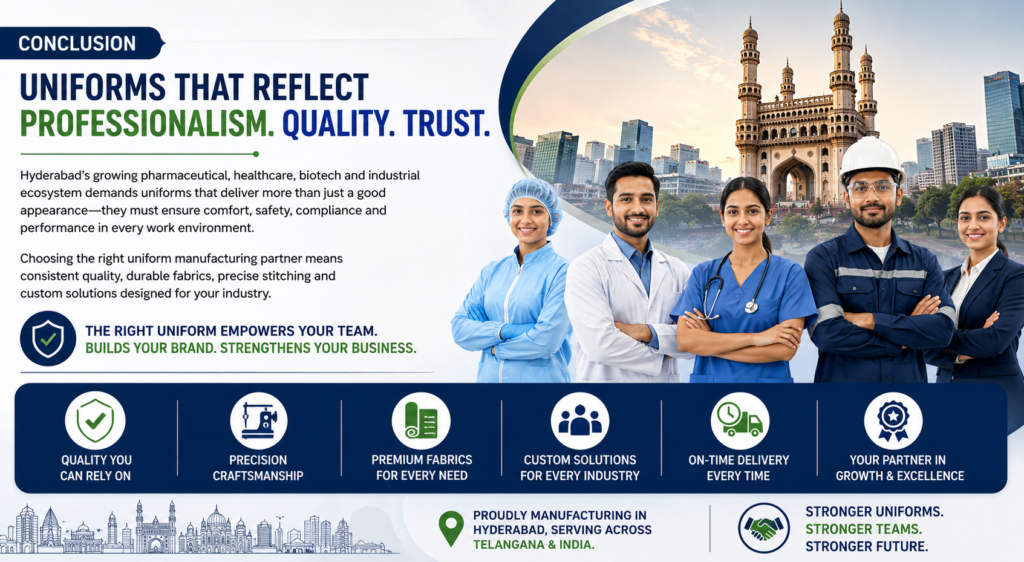
The market for uniform manufacturers in Hyderabad is evolving alongside the city’s pharmaceutical, healthcare, biotechnology and medical-device industries.
Hyderabad’s extensive life-sciences ecosystem, including Genome Valley, the Medical Devices Park and pharmaceutical manufacturing clusters, creates demand for workwear ranging from conventional corporate uniforms to highly specialized cleanroom and ESD apparel. (Invest Telangana)
For businesses, the right uniform manufacturer should therefore be selected based on more than price or appearance.
Look for a manufacturing partner that understands:
Fabric → Construction → Application → Safety → Branding → Consistency
Whether you are managing uniforms for a hospital in Hyderabad, a pharmaceutical facility in Genome Valley, a medical-device manufacturer in Sultanpur, or an industrial operation in Rangareddy, a well-engineered uniform programme can improve employee identification, comfort, durability and operational consistency.
As Hyderabad continues to strengthen its position as a major life-sciences and manufacturing hub, the demand for technically designed, customized and application-specific uniforms is likely to grow alongside the industries that use them.
Frequently Asked Questions About Uniform Manufacturers in Hyderabad
What do uniform manufacturers in Hyderabad produce?
Depending on their capabilities, manufacturers can produce corporate uniforms, industrial workwear, hospital uniforms, lab coats, pharmaceutical garments, cleanroom apparel, ESD clothing, housekeeping uniforms and customized institutional garments.
Which industries need customized uniforms in Hyderabad?
Pharmaceuticals, hospitals, diagnostic centres, biotechnology, medical devices, electronics, manufacturing, education, hospitality, logistics and facility management companies can all require customized uniforms.
Can uniform manufacturers supply pharmaceutical companies?
Yes. Specialized manufacturers can produce production uniforms, lab coats, cleanroom garments and other apparel according to the requirements of pharmaceutical facilities.
What is the best fabric for industrial uniforms?
There is no single best fabric. Cotton, poly-cotton, polyester and technical fabrics each have different advantages. The correct choice depends on the work environment, durability requirements, comfort and any special performance requirements.
Can uniforms be customized with company branding?
Yes. Customization can include logos, embroidery, employee names, department identification, brand colours, labels and specific garment designs.
Are cleanroom garments the same as regular uniforms?
No. Cleanroom garments are specifically designed for controlled environments where particle and contamination control are important. A conventional uniform should not automatically be treated as cleanroom apparel.
