

Cleanroom Clothing Around the World: How Global Standards Shape Pharmaceutical, Biotechnology, Healthcare, and Research Excellence

Cleanroom clothing continues to play an increasingly vital role in contamination control in highly regulated industries such as pharmaceuticals, biotechnology, healthcare, medical research, food processing, and advanced manufacturing. Unlike conventional protective clothing that primarily safeguards workers from workplace hazards, cleanroom clothing is specifically engineered to prevent personnel from contaminating products, processes, and controlled environments. Every person working inside a cleanroom continuously sheds skin cells, hair, and microorganisms, making personnel one of the largest potential sources of contamination.
International regulatory authorities recognize that contamination control cannot rely on facility design alone. Effective contamination prevention requires a comprehensive contamination control strategy that combines facility engineering, environmental monitoring, validated cleaning procedures, personnel training, and properly designed cleanroom clothing. Modern Good Manufacturing Practice (GMP) regulations consistently emphasize that garments are one component of an integrated quality management system rather than a standalone solution.
Today, countries leading the global pharmaceutical, biotechnology, medical device, and healthcare industries—including the United States, Germany, Switzerland, Japan, Singapore, and South Korea—share a common characteristic: rigorous implementation of contamination control practices supported by scientifically designed cleanroom clothing and strict regulatory oversight. While cleanroom clothing alone does not determine industrial success, it contributes significantly to maintaining product quality, regulatory compliance, patient safety, and international confidence in manufacturing operations.
This article compares how different countries regulate cleanroom clothing, examines the industries where these standards are most critical, and analyzes how comprehensive contamination control practices support global competitiveness.
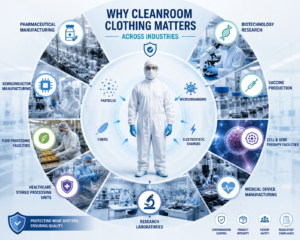
Why Cleanroom Clothing Matters Across Industries
The primary purpose of cleanroom clothing is to minimize contamination originating from personnel. Specialized garments are designed to reduce the release of particles, fibers, microorganisms, and electrostatic charges into controlled environments.
Industries where cleanroom clothing is indispensable include:
- Pharmaceutical manufacturing
- Biotechnology research
- Vaccine production
- Cell and gene therapy facilities
- Medical device manufacturing
- Research laboratories
- Healthcare sterile processing units
- Food processing facilities with high hygiene requirements
- Semiconductor manufacturing
- Advanced electronics production
International standards such as ISO 14644 define cleanroom classifications based on airborne particle concentrations, while GMP regulations issued by regulatory authorities establish requirements for gowning procedures, contamination control, personnel hygiene, and manufacturing practices. These frameworks work together to ensure products remain safe, effective, and consistently manufactured. The recent revision of EU GMP Annex 1 further strengthened expectations for contamination control by requiring manufacturers of sterile medicinal products to implement a comprehensive Contamination Control Strategy (CCS), with personnel gowning forming an essential element of that strategy.
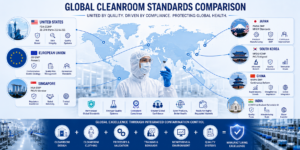
United States: Science-Based Regulation and Strict GMP Compliance
The United States remains one of the world’s largest pharmaceutical and biotechnology markets, supported by rigorous regulatory oversight from the U.S. Food and Drug Administration (FDA). Pharmaceutical manufacturers are required to comply with Current Good Manufacturing Practice (CGMP) regulations contained in 21 CFR Parts 210 and 211, which establish legally enforceable requirements for personnel practices, sanitation, equipment, facilities, and production controls. Although these regulations do not prescribe specific garment designs, they require manufacturers to use appropriate clothing and protective apparel wherever necessary to prevent contamination.
For sterile drug manufacturing, the FDA also recognizes internationally accepted contamination-control principles, including guidance aligned with ISO 14644 and risk-based environmental control practices. Companies manufacturing injectable medicines, biologics, vaccines, and advanced therapies therefore implement comprehensive gowning programs using validated cleanroom clothing, including coveralls, hoods, masks, goggles, sterile gloves, and dedicated footwear.
The biotechnology sector follows similar expectations because biologic products, monoclonal antibodies, cell therapies, and gene therapies are particularly sensitive to microbial contamination. Research laboratories handling sterile cultures likewise depend on appropriate cleanroom clothing to protect experimental integrity.
These regulatory expectations have helped establish a manufacturing environment recognized worldwide for quality, traceability, and regulatory compliance. The United States consistently ranks among the world’s largest pharmaceutical markets and remains a global leader in biotechnology innovation, supported by strong quality systems, scientific research, and effective regulatory enforcement. While cleanroom clothing contributes to contamination prevention, this success is also driven by investment in research, advanced manufacturing technologies, workforce training, and comprehensive quality management systems.
European Union: Harmonized Standards for Pharmaceutical Excellence
The European Union has developed one of the world’s most comprehensive pharmaceutical regulatory systems. Manufacturing facilities supplying medicines across EU member states must comply with EU Good Manufacturing Practice (EU GMP) requirements, administered through national competent authorities and coordinated by the European Medicines Agency (EMA).
A defining feature of the European approach is EU GMP Annex 1, which governs the manufacture of sterile medicinal products. The revised Annex 1 places significant emphasis on contamination prevention throughout the manufacturing lifecycle. It requires manufacturers to establish a documented Contamination Control Strategy (CCS) that integrates facility design, utilities, environmental monitoring, cleaning, personnel qualification, and cleanroom clothing into a unified quality system.
European pharmaceutical facilities typically implement structured gowning procedures based on cleanroom classifications. Personnel entering higher-grade cleanrooms wear sterile cleanroom clothing specifically designed to minimize particle shedding while maintaining wearer comfort and mobility. Garments are validated, regularly inspected, professionally laundered under controlled conditions, and replaced according to documented quality procedures.
These requirements extend beyond pharmaceutical manufacturing into biotechnology facilities, vaccine production, medical device manufacturing, research laboratories, and specialized healthcare environments where contamination control directly affects patient safety and product quality.
Countries such as Germany, Switzerland (although not an EU member, it closely aligns with European GMP expectations through mutual recognition frameworks), Ireland, Belgium, and the Netherlands have become internationally respected pharmaceutical manufacturing hubs. Their success reflects decades of investment in scientific innovation, skilled workforces, regulatory consistency, advanced manufacturing infrastructure, and comprehensive contamination control practices that include high-performance cleanroom clothing.
Japan: Precision Manufacturing Supported by Quality Culture
Japan has earned a global reputation for manufacturing precision, reliability, and continuous quality improvement. The country’s pharmaceutical industry operates under Good Manufacturing Practice requirements administered by the Ministry of Health, Labour and Welfare (MHLW) and the Pharmaceuticals and Medical Devices Agency (PMDA).
Japanese pharmaceutical manufacturers emphasize contamination prevention through disciplined operational procedures, personnel qualification, and carefully controlled cleanroom environments. Facilities producing sterile medicines, biologics, regenerative medicine products, and medical devices employ validated cleanroom clothing systems designed to reduce particle generation while supporting worker comfort during extended manufacturing operations.
Beyond pharmaceuticals, Japan applies similarly rigorous contamination control principles in biotechnology research, semiconductor manufacturing, precision electronics, and advanced medical technologies. This cross-industry commitment to quality has reinforced Japan’s reputation for producing highly reliable products that meet demanding international regulatory expectations.
It is important to recognize that Japan’s manufacturing success cannot be attributed solely to cleanroom clothing. Rather, it reflects an integrated quality culture that combines disciplined operational practices, technological innovation, employee training, process validation, and stringent regulatory oversight. Within this broader framework, scientifically designed cleanroom clothing serves as an essential barrier that helps preserve product sterility and manufacturing consistency.
Cleanroom Clothing Standards in Singapore, South Korea, China, and India
Singapore: Regulatory Excellence Supporting a Global Biopharmaceutical Hub
Despite its relatively small size, Singapore has become one of the world’s leading pharmaceutical and biotechnology manufacturing hubs. Global companies including Pfizer, GSK, Sanofi, AbbVie, Roche, Thermo Fisher Scientific, and Lonza have established major manufacturing or research facilities in the country. This success is supported by a highly predictable regulatory environment, skilled workforce, advanced infrastructure, and stringent quality standards.
The Health Sciences Authority (HSA) regulates pharmaceutical manufacturing through Good Manufacturing Practice (GMP) requirements that are aligned with the Pharmaceutical Inspection Co-operation Scheme (PIC/S) GMP Guide, one of the world’s most widely recognized pharmaceutical quality frameworks. Manufacturers must implement comprehensive contamination control measures, including validated gowning procedures, environmental monitoring, personnel qualification, and appropriate cleanroom clothing for controlled manufacturing environments.
Facilities manufacturing sterile medicines, biologics, vaccines, and advanced therapy medicinal products typically require sterile cleanroom clothing consisting of coveralls, hoods, masks, sterile gloves, protective footwear, and garments manufactured from low-linting, particle-controlled fabrics. Gowning procedures are validated, documented, and routinely audited to ensure consistent contamination control.
Singapore also applies similarly rigorous standards in biomedical research laboratories, medical technology manufacturing, and healthcare-related cleanroom facilities. Government investment through agencies such as the Economic Development Board (EDB), together with consistent regulatory enforcement, has enabled Singapore to become one of Asia’s most trusted pharmaceutical manufacturing destinations.
It would be inaccurate to suggest that cleanroom clothing alone created this success. Rather, Singapore’s competitiveness results from an integrated ecosystem that combines strict GMP compliance, investment in innovation, regulatory transparency, highly trained personnel, and robust contamination control practices in which cleanroom clothing plays a critical supporting role.
South Korea: Advanced Manufacturing Driven by GMP Compliance
South Korea has rapidly emerged as a global leader in pharmaceutical manufacturing, biotechnology, biosimilars, vaccines, and contract development and manufacturing (CDMO). Companies such as Samsung Biologics and Celltrion have positioned the country among the world’s most important producers of biologic medicines.
The Ministry of Food and Drug Safety (MFDS) regulates pharmaceutical manufacturing under Korean Good Manufacturing Practice (KGMP), which aligns closely with internationally recognized GMP principles and PIC/S guidance. Manufacturers producing sterile pharmaceuticals are expected to implement validated contamination control systems, personnel hygiene procedures, environmental monitoring, and appropriate cleanroom clothing based on cleanroom classifications and manufacturing risks.
Biotechnology facilities manufacturing monoclonal antibodies, biosimilars, vaccines, and cell culture products depend heavily on contamination prevention because biological products are highly susceptible to microbial contamination. Personnel therefore wear specialized cleanroom clothing that minimizes particle shedding while maintaining comfort during extended production activities.
South Korea also maintains rigorous cleanroom practices within semiconductor manufacturing, medical device production, and advanced research laboratories. The country’s strong emphasis on engineering excellence, quality assurance, automation, and regulatory compliance has strengthened its international reputation as a reliable manufacturer of high-value products.
The country’s rise reflects decades of investment in research and development, advanced manufacturing capabilities, workforce education, and comprehensive quality systems. Within these systems, cleanroom clothing supports contamination control but functions alongside validated processes, modern facilities, environmental monitoring, and continuous regulatory oversight.
China: Rapid Expansion with Increasing Regulatory Harmonization
China has become one of the world’s largest pharmaceutical manufacturing markets and continues to expand its biotechnology, vaccine, and medical device industries. In recent years, the country has undertaken substantial regulatory reforms to improve manufacturing quality and align more closely with international GMP expectations.
The National Medical Products Administration (NMPA) oversees pharmaceutical regulation, while Chinese GMP requirements incorporate contamination control principles that emphasize personnel hygiene, environmental monitoring, facility design, equipment qualification, and appropriate cleanroom clothing.
Manufacturers producing sterile medicines, vaccines, biologics, and active pharmaceutical ingredients (APIs) employ validated cleanroom clothing systems that reduce particle generation and support contamination prevention. Large pharmaceutical manufacturers supplying regulated international markets frequently design their facilities to comply not only with Chinese GMP but also with FDA, EU GMP, or PIC/S expectations to facilitate exports.
China’s biotechnology sector has experienced remarkable growth through sustained investment in research, innovation, manufacturing capacity, and regulatory modernization. Cleanroom facilities supporting pharmaceutical production, life science research, and medical technology manufacturing increasingly adopt internationally recognized contamination control practices.
Although regulatory reforms have significantly strengthened quality systems, China’s manufacturing success is driven by multiple factors, including industrial investment, infrastructure development, scientific research, skilled personnel, and expanding regulatory oversight. Within this broader framework, properly validated cleanroom clothing remains an essential component of contamination control rather than the sole determinant of manufacturing quality.
India: Building Global Trust Through Quality Manufacturing
India is widely recognized as one of the world’s largest producers of generic medicines and vaccines. The country supplies pharmaceutical products to more than 200 countries and hosts thousands of manufacturing facilities serving domestic and international markets. India’s pharmaceutical industry has earned a strong global reputation for affordable, high-quality medicines while continuing to expand its biotechnology, vaccine, medical device, and research sectors.
The Central Drugs Standard Control Organisation (CDSCO) regulates pharmaceutical manufacturing in India through the Drugs and Cosmetics Act and Rules, while Revised Schedule M, aligned more closely with WHO GMP principles, strengthens expectations regarding pharmaceutical quality systems, contamination control, facility design, environmental monitoring, personnel practices, and documentation. Many Indian manufacturers exporting medicines to regulated markets also comply with US FDA, EU GMP, MHRA, WHO GMP, or PIC/S-related requirements depending on their target markets.
In pharmaceutical manufacturing, sterile injectable facilities, biotechnology plants, vaccine manufacturers, research laboratories, and medical device manufacturers implement validated gowning procedures using specialized cleanroom clothing appropriate for their cleanroom classifications. Proper cleanroom clothing minimizes particle shedding, supports aseptic manufacturing, and helps manufacturers meet international regulatory expectations during inspections.
India’s food processing industry also increasingly applies hygienic protective garments and cleanroom clothing concepts in high-risk production environments, particularly in facilities manufacturing infant nutrition, nutraceuticals, and sensitive food products where contamination control directly affects consumer safety.
India’s growing international reputation reflects continuous improvements in manufacturing infrastructure, regulatory modernization, skilled scientific talent, and quality management systems. The country’s leadership in vaccine production and generic pharmaceuticals has been achieved through investment in research, manufacturing capacity, regulatory compliance, and export-oriented quality standards. Cleanroom clothing contributes significantly to these quality systems by reducing contamination risks and supporting compliance with global GMP requirements.
How Comprehensive Cleanroom Clothing Practices Support Global Industry Leadership
A comparison of the world’s leading pharmaceutical and biotechnology nations reveals a consistent pattern. Countries with internationally respected manufacturing sectors invest heavily in contamination control systems that include validated cleanroom clothing, modern cleanroom infrastructure, environmental monitoring, quality assurance, personnel training, and strong regulatory oversight.
However, cleanroom clothing functions as one critical element within an integrated quality ecosystem that enables manufacturers to consistently produce safe, effective, and compliant products.
Across each of these countries, cleanroom clothing contributes to the following measurable operational benefits:
- Reduced particle contamination within controlled environments.
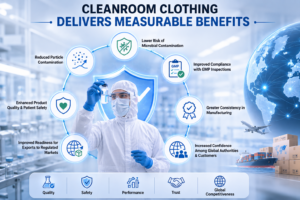
- Lower risk of microbial contamination during aseptic manufacturing.
- Improved compliance with GMP inspections.
- Greater consistency in pharmaceutical and biotechnology manufacturing.
- Enhanced product quality and patient safety.
- Increased confidence among global regulatory authorities and international customers.
- Improved readiness for exports to highly regulated markets.
These outcomes strengthen manufacturing performance and regulatory compliance, but they arise from comprehensive quality management systems rather than from cleanroom clothing in isolation.
The Future of Cleanroom Clothing
As pharmaceutical manufacturing evolves toward biologics, cell therapies, gene therapies, personalized medicine, and increasingly complex sterile products, contamination control requirements will continue to become more stringent.
Future innovations in cleanroom clothing are expected to include: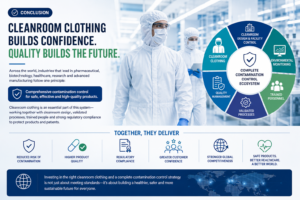
- Improved low-linting technical fabrics.
- Enhanced electrostatic discharge (ESD) protection.
- Greater wearer comfort during extended manufacturing operations.
- Reusable garments with validated long-term performance.
- Sustainable manufacturing materials that maintain contamination control performance.
- Smart textiles capable of supporting digital quality monitoring.
Regulatory authorities worldwide are also placing greater emphasis on risk-based contamination control strategies, making cleanroom clothing an increasingly important component of modern pharmaceutical quality systems.
Conclusion
Around the world, the most successful pharmaceutical, biotechnology, healthcare, research, and advanced manufacturing industries share a common commitment to contamination control. Although regulatory approaches differ slightly between the United States, European Union, Japan, Singapore, South Korea, China, and India, every leading regulatory authority recognizes the importance of appropriate cleanroom clothing within Good Manufacturing Practice.
The evidence clearly shows that cleanroom clothing supports manufacturing excellence by minimizing contamination risks, protecting product quality, improving regulatory compliance, and reinforcing patient safety. Nevertheless, cleanroom clothing should always be viewed as one essential element of a broader quality management system that also includes cleanroom engineering, environmental monitoring, personnel training, validated processes, and continuous regulatory compliance.
For organizations operating in pharmaceutical manufacturing, biotechnology, healthcare, research laboratories, medical device production, or food processing, investing in high-quality cleanroom clothing is not merely about meeting regulations—it is about supporting operational excellence, maintaining international competitiveness, and delivering products that consistently meet the highest global quality standards.
Frequently Asked Questions (FAQs)
Why is cleanroom clothing important in pharmaceutical manufacturing?
Cleanroom clothing helps minimize particle and microbial contamination generated by personnel. It supports aseptic manufacturing, regulatory compliance, product quality, and patient safety by reducing one of the primary sources of contamination within cleanrooms.
Which industries require cleanroom clothing?
Industries that commonly require cleanroom clothing include pharmaceutical manufacturing, biotechnology, medical device production, healthcare, research laboratories, vaccine manufacturing, semiconductor fabrication, electronics manufacturing, and high-hygiene food processing.
What international standards govern cleanroom clothing?
While no single standard specifies all garment requirements, cleanroom clothing is typically used within facilities operating under ISO 14644 cleanroom classifications, WHO GMP, PIC/S GMP, FDA Current Good Manufacturing Practice (21 CFR Parts 210 and 211), and EU GMP Annex 1 contamination control requirements.
Which countries have the strictest cleanroom clothing requirements?
Leading pharmaceutical manufacturing countries—including the United States, Germany, Japan, Singapore, South Korea, Switzerland, and other European nations—maintain rigorous contamination control systems that include validated cleanroom clothing as part of comprehensive GMP compliance.
Does cleanroom clothing alone improve manufacturing quality?
Yes, but not directly. Cleanroom clothing is an essential contamination-control measure, but manufacturing quality depends on multiple interconnected factors, including facility design, HVAC systems, personnel training, environmental monitoring, cleaning validation, process control, and quality management systems.
