

Lab Coat in Chandigarh: Technical Guide to Lab Apparel and Pan-India Supply

Lab coat in Chandigarh – The demand is closely connected with the growth of pharmaceutical manufacturing, healthcare, biotechnology, research, diagnostics, education, and industrial operations across the Chandigarh–Mohali–Panchkula region.
For these industries, a lab coat is much more than a white uniform. Fabric composition, GSM, seam construction, closure systems, fit, laundering characteristics, and electrostatic properties can all influence the suitability of a garment for a particular working environment.
Chandigarh also offers a strategic advantage for lab apparel manufacturing and distribution. Located within a highly connected North Indian industrial corridor, the city provides access to major pharmaceutical, healthcare, manufacturing, and commercial centres.
This makes the Chandigarh–Mohali region a practical manufacturing and distribution base for supplying lab coats and industrial apparel across India.
For organizations looking for a lab coat manufacturer in Chandigarh, the combination of technical manufacturing capability and geographic connectivity can support a more responsive and resilient supply chain.
What Makes a Lab Coat Different from Ordinary Workwear?
A lab coat is designed to provide an additional protective layer between the wearer, personal clothing, and the surrounding work environment.
Depending on the application, a lab coat may need to provide:
- Protection against minor liquid splashes
- Separation between personal clothing and the work environment
- Reduced particle shedding
- Controlled electrostatic behaviour
- Resistance to repeated washing
- Dimensional stability
- Mechanical durability
- Comfortable thermal performance
- Consistent sizing
The required specifications depend on the work being performed.
For example, a college chemistry lab may require a comfortable and durable cotton or poly-cotton coat. A pharmaceutical quality-control lab in Baddi may require a garment with different fabric and contamination-control characteristics. An electronics manufacturing facility in Noida or Bengaluru may require anti-static or ESD properties.
Therefore, the right lab coat should be selected according to its application rather than appearance alone.
Technical Factors to Consider When Selecting a Lab Coat
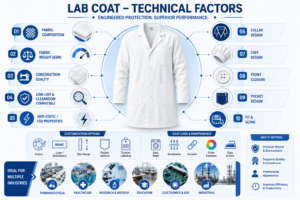
When purchasing a lab coat in Chandigarh, businesses should establish technical requirements before selecting a garment.
Fabric Composition
Fabric composition influences comfort, durability, dimensional stability, moisture behaviour, and maintenance requirements.
Common options include:
Cotton
Cotton provides good breathability and wearer comfort. It is commonly used for general-purpose applications such as educational labs, clinics, research environments, and non-controlled industrial settings.
Polyester-Cotton Blends
Poly-cotton fabrics combine the comfort of cotton with the durability and dimensional stability of polyester. They are widely used for professional workwear where garments require regular washing.
Polyester Technical Fabrics
Specialized polyester fabrics can be engineered for applications where low-lint characteristics, dimensional stability, or controlled electrostatic behaviour are important.
These fabrics can be particularly relevant to pharmaceutical, electronics, biotechnology, and controlled manufacturing environments.
Anti-Static or ESD Fabrics
These fabrics incorporate conductive or dissipative elements to help control electrostatic charge.
They can be used in environments such as electronics assembly, semiconductor manufacturing, precision engineering, and other ESD-sensitive operations.
Fabric GSM and Performance- Lab Coat in Chandigarh
GSM, or grams per square metre, indicates the weight of the fabric and is an important parameter when specifying a lab coat.
A heavier fabric may provide increased durability and coverage but can increase thermal load. A lighter fabric can improve breathability and comfort but still needs adequate strength for the intended application.
The appropriate GSM should therefore be determined by factors such as:
- Working temperature
- Duration of wear
- Required durability
- Frequency of washing
- Required coverage
- Worker’s mobility
- Application-specific protection
For example, a lightweight coat may be suitable for a warm pharmaceutical production environment, while a heavier fabric may be preferred for applications where increased durability is required.
There is no universal GSM specification that is appropriate for every lab coat.
Seam Construction and Stitch Quality
The performance of a garment depends on more than its fabric.
Important construction parameters include:
- Stitch density
- Seam allowance
- Thread selection
- Reinforcement at stress points
- Sleeve attachment
- Pocket reinforcement
- Collar construction
- Hem finishing
This becomes particularly important for pharmaceutical companies and institutions purchasing reusable garments in large quantities.
For example, if a pharmaceutical facility in Baddi Industrial Area uses the same coat across its quality-control and R&D teams, inconsistent stitching or sizing between batches can create unnecessary replacement and procurement issues.
A professional manufacturer should therefore maintain documented garment specifications throughout production.
Collar and Cuff Design
Collar and cuff design should be selected according to the working environment.
A conventional open cuff can provide greater ventilation and ease of movement. Elasticated or knitted cuffs can provide closer wrist coverage and reduce the possibility of loose sleeves interfering with work.
Similarly, conventional shirt collars may be suitable for general-purpose coats, while more enclosed collar configurations may be considered for controlled environments.
For a pharmaceutical QC lab, microbiology facility, or controlled production area, these details can become more important than they would be in a college science lab.
Front Closure Systems
Lab coats may use:
- Buttons
- Press studs
- Concealed buttons
- Zippers
- Other specialized fastening systems
The selection depends on the application.
For general workwear, conventional buttons may be sufficient. In controlled environments, concealed closures may be preferred because they reduce exposed components and can simplify cleaning.
The fastening system should also withstand repeated opening, closing, washing, and drying.
Pocket Configuration
Pockets provide practical storage for pens, markers, notebooks, identification cards, and other small accessories.
However, pocket configuration should be considered carefully in controlled environments.
For a university or college lab, two or three functional pockets may be useful.
For a pharmaceutical or controlled manufacturing environment, unnecessary external features may be minimized because they can create additional surfaces where particles or contaminants could accumulate.
Manufacturers can therefore customize pocket placement and construction according to the application.
Low-Lint and Cleanroom-Compatible Lab Coats in Chandigarh
Not every lab requires cleanroom apparel.
However, facilities involved in sterile manufacturing, biotechnology, medical devices, semiconductor production, or sensitive research may have significantly stricter contamination-control requirements.
For example, a pharmaceutical manufacturing unit in Baddi operating controlled production areas may require personnel apparel with specific particle-control characteristics.
A cleanroom-compatible lab coat may incorporate:
- Low-lint fabric
- Low particle-shedding construction
- Appropriate seam design
- Controlled garment accessories
- Suitable laundering procedures
- Anti-static properties where required
A conventional lab coat should not automatically be considered suitable for a classified cleanroom.
The garment must be selected according to the facility’s classification, gowning procedure, contamination-control programme, and operational requirements.
Anti-Static Lab Coats in Chandigarh for ESD-Sensitive Environments
Electrostatic discharge can damage sensitive electronic components and create operational risks in certain manufacturing environments.
An anti-static lab coat in Chandigarh can be manufactured using fabrics containing conductive fibres or other technologies designed to control electrostatic charge.
Such garments can be relevant to:
- Electronics assembly units
- Semiconductor facilities
- PCB manufacturing
- Precision engineering
- Electronics R&D centres
- Medical electronics manufacturing
For example, an electronics manufacturer in Mohali, Noida, Bengaluru, or Hyderabad may have requirements that are very different from those of a pharmaceutical QC lab.
The lab coat should therefore be evaluated as part of the facility’s complete ESD control programme, including footwear, flooring, workstations, grounding, and personnel procedures.
Lab Coats in Chandigarh for Pharmaceutical Companies and Nearby Industrial Areas
The Chandigarh–Mohali region is strategically connected to several important pharmaceutical manufacturing locations in North India.
Baddi and Nalagarh in Himachal Pradesh, for example, are major pharmaceutical manufacturing locations located relatively close to Chandigarh.
Pharmaceutical companies may use lab coats across:
- Quality Control departments
- Quality Assurance functions
- Analytical testing
- Microbiology
- Research and Development
- Sampling areas
- Stability testing
- Formulation development
- Production-support areas
A manufacturer serving this region can therefore support both local customers and pharmaceutical companies operating throughout the wider North Indian manufacturing belt.
Lab Coats in Chandigarh for Hospitals and Diagnostic Centres
Hospitals and healthcare facilities represent another important application for lab apparel.
Examples around Chandigarh and the wider region include:
- Hospitals
- Pathology labs
- Diagnostic centres
- Medical colleges
- Dental colleges
- Clinical research facilities
- Blood testing facilities
Doctors, pharmacists, lab technicians, researchers, and other healthcare professionals may require different coat designs depending on their role.
Healthcare organizations can also order customized garments featuring:
- Hospital logos
- Employee names
- Department identification
- Custom colours
- Different fits
- Embroidery
For a large hospital group, standardized lab coats can simplify procurement and maintain a consistent professional appearance across departments.
Lab Coats for Colleges, Universities and Research Institutes
Educational institutions are another major application.
Universities and colleges may require lab coats for:
- Chemistry labs
- Biology labs
- Microbiology labs
- Pharmacy labs
- Biotechnology labs
- Engineering labs
- Medical training facilities
Institutions may need hundreds or thousands of garments across multiple sizes.
For example, universities and technical institutions in Chandigarh, Mohali, Patiala, Ludhiana, Delhi, Jaipur, Dehradun, and other education hubs may require recurring supplies for students and faculty.
For these buyers, durability, affordability, sizing consistency, and bulk-production capacity become important procurement criteria.
Customized Lab Coats in Chandigarh for Industrial and Corporate Buyers Across India
Industrial organizations often require garments that match their operational and branding requirements.
Customization can include:
- Fabric composition
- GSM
- Colour
- Collar style
- Sleeve design
- Cuff configuration
- Pocket layout
- Closure system
- Company logo
- Employee name
- Department identification
- Size range
- Packaging
- Garment labelling
For example, a pharmaceutical company may use one colour for QC personnel and another for production-support teams.
Similarly, a university may require its institutional logo embroidered on every coat.
A capable lab coat manufacturer in Chandigarh can develop these specifications into a repeatable production standard.
Why Chandigarh Is Strategically Positioned for Lab Apparel Manufacturing

The location of a garment manufacturing facility can have a direct effect on supply-chain efficiency.
A technically capable supplier may still create procurement challenges if customers are located thousands of kilometres away and replenishment depends on long or vulnerable transportation routes.
Chandigarh has a strategic advantage because it sits within a highly connected North Indian economic corridor.
The Chandigarh–Mohali–Panchkula region provides access to several important industrial and commercial markets.
These include:
- Punjab
- Haryana
- Himachal Pradesh
- Delhi-NCR
- Uttarakhand
- Jammu and Kashmir
- Uttar Pradesh
- Rajasthan
This geographical position allows a manufacturer to serve a substantial portion of North India’s industrial base while also maintaining distribution links to western, central, southern, and eastern markets.
Chandigarh and the Baddi Pharmaceutical Cluster
One of Chandigarh’s most relevant supply-chain advantages is its proximity to the pharmaceutical manufacturing ecosystem of Baddi, Barotiwala, and Nalagarh.
These areas contain pharmaceutical manufacturers, formulation units, packaging facilities, suppliers, and associated industrial businesses.
For a lab apparel manufacturer, being positioned relatively close to this cluster can provide practical benefits:
- Faster sampling
- Easier customer visits
- Shorter regional transportation
- More responsive replenishment
- Reduced dependence on long-distance shipping
- Easier technical coordination
This is particularly valuable for customers that require recurring garment supplies.
Connecting North Indian Industrial Markets
Chandigarh’s strategic position extends beyond the pharmaceutical sector.
A manufacturer can serve customers in multiple industrial clusters across North India.
For example:
Punjab:
Ludhiana, Amritsar, Jalandhar, Rajpura, Mohali and other manufacturing centres.
Haryana:
Gurugram, Faridabad, Panipat, Ambala and other industrial locations.
Himachal Pradesh:
Baddi, Nalagarh, Sirmaur and other industrial areas.
Uttarakhand:
Haridwar, Rudrapur, Pantnagar and surrounding industrial zones.
Delhi-NCR:
Noida, Greater Noida, Gurugram, Ghaziabad and Faridabad.
Rajasthan:
Jaipur, Bhiwadi, Neemrana and other industrial clusters.
This network creates a strong regional market for specialized workwear, pharmaceutical garments, lab coats, cleanroom apparel, and ESD clothing.
Chandigarh as a Base for a Resilient Pan-India Supply Chain
Supply-chain resilience means being able to continue manufacturing and delivering products despite fluctuations in demand, transportation constraints, supplier disruptions, or regional changes.
For workwear manufacturers, this is especially important because customers such as pharmaceutical companies, hospitals, and educational institutions often require recurring supplies.
A Chandigarh-based manufacturing operation can support resilience through several mechanisms.
1. Regional Manufacturing
Production close to major North Indian customers can reduce dependence on distant suppliers.
2. Faster Regional Replenishment
Customers in Punjab, Haryana, Himachal Pradesh, Delhi-NCR, Uttarakhand, and Rajasthan can potentially be served through shorter distribution routes.
3. Pan-India Distribution
Once garments are manufactured and quality-checked, they can be dispatched through established logistics networks to markets across India.
4. Standardized Production
Documented specifications allow repeat orders to maintain consistent fabric, dimensions, construction, and finishing.
5. Multiple Customer Markets
Serving pharmaceutical, healthcare, education, electronics, research, and industrial customers diversifies demand.
This is important because a resilient supply chain should not depend on a single industry, customer, or geographic market.
Supplying Lab Coats Across India from Chandigarh
A manufacturer serving the lab coat in Chandigarh market can use the region as a base for national distribution.
Potential markets include:
- Punjab
- Haryana
- Himachal Pradesh
- Delhi-NCR
- Uttarakhand
- Uttar Pradesh
- Rajasthan
- Jammu and Kashmir
- Gujarat
- Maharashtra
- Madhya Pradesh
- Telangana
- Karnataka
- Tamil Nadu
- Andhra Pradesh
- West Bengal
- Other Indian states
For customers in southern or eastern India, geographic distance naturally becomes greater. However, an organized manufacturing operation can overcome this through planned production, inventory management, standardized packaging, and established logistics partnerships.
The objective is therefore not simply to be geographically close to every customer. It is to establish a reliable manufacturing and distribution system capable of serving customers across multiple regions.
Quality Control in Lab Coat Manufacturing
Quality control should be incorporated throughout the production cycle rather than performed only at the final stage.
A structured process may include:
Incoming Fabric Inspection
Checking fabric composition, GSM, colour, width, defects, and other specified parameters.
Cutting Inspection
Ensuring accurate panel dimensions, marker utilization, and size consistency.
Stitching Inspection
Checking seam integrity, stitch quality, thread tension, reinforcement, and construction.
Finishing Inspection
Checking loose threads, pressing, closures, labels, embroidery, and overall appearance.
Measurement Inspection
Verifying key dimensions such as chest, sleeve length, coat length, shoulder width, and cuff dimensions.
Final Inspection
Checking workmanship, defects, sizing, packaging, labelling, and order specifications before dispatch.
For pharmaceutical companies and other institutional buyers, maintaining these specifications across repeat production batches is particularly important.
What Should You Specify When Buying Lab Coats?
Procurement teams should define their requirements before requesting a quotation.
Important specifications include:
- Intended application
- Fabric composition
- GSM
- Colour
- Size range
- Collar design
- Sleeve design
- Cuff configuration
- Closure system
- Pocket configuration
- ESD requirements
- Low-lint requirements
- Laundering method
- Logo and embroidery requirements
- Packaging
- Expected order quantity
- Replenishment frequency
- Delivery schedule
This technical approach makes it easier to compare manufacturers on an equivalent basis.
Lab Coat in Chandigarh: Local Manufacturing with a National Reach
The requirement for a lab coat in Chandigarh reflects the wider growth of pharmaceutical, healthcare, research, education, electronics, and industrial activity across North India.
Chandigarh’s location adds another important dimension to the manufacturing opportunity.
Its proximity to Baddi-Nalagarh, access to the Chandigarh–Mohali–Panchkula industrial ecosystem, and connectivity with major markets such as Delhi-NCR, Punjab, Haryana, Uttarakhand, Rajasthan, and Uttar Pradesh make it strategically positioned for industrial apparel distribution.
For a manufacturer, this means the same production base can serve nearby customers while supporting a wider pan-India distribution network.
For buyers, it means access to a regional manufacturing partner that can potentially provide:
- Technical garment customization
- Consistent production specifications
- Bulk manufacturing
- Repeat-order capability
- Quality control
- Regional responsiveness
- Pan-India distribution
Choosing the Right Lab Coat Manufacturer in Chandigarh
Price is an important procurement consideration, but it should not be the only factor.
Businesses should evaluate a manufacturer based on:
- Fabric quality
- Technical understanding
- Garment construction
- Production capacity
- Quality-control systems
- Customization capability
- Size consistency
- Repeat-order reliability
- Packaging
- Delivery capability
- Pan-India distribution support
A reliable manufacturing partner should be able to understand the customer’s application and translate technical requirements into a consistent garment specification.
Frequently Asked Questions
Where can I buy a lab coat in Chandigarh?
Lab coats can be sourced from specialized industrial garment, protective clothing, and lab apparel manufacturers serving Chandigarh, Mohali, Panchkula, and the wider North Indian market like Corlink.
Which fabric is best for a lab coat?
There is no single fabric suitable for every application. Cotton, poly-cotton, polyester, and technical anti-static fabrics can all be appropriate depending on the environment and required performance.
Can lab coats be customized?
Yes. Manufacturers can customize fabric, GSM, colour, sizing, collar, cuffs, pockets, closures, embroidery, branding, and packaging.
Can a Chandigarh manufacturer supply lab coats across India?
Yes. With suitable production capacity, inventory planning, packaging, and logistics arrangements, a Chandigarh-based manufacturer can supply customers across India.
Are standard lab coats suitable for cleanrooms?
Not necessarily. Classified cleanrooms may require specially designed garments with appropriate particle-control, low-lint, electrostatic, and construction characteristics.
Why is Chandigarh a good location for lab apparel manufacturing?
Chandigarh is strategically positioned near major North Indian industrial markets and pharmaceutical clusters such as Baddi-Nalagarh. Its connectivity also allows manufacturers to distribute products to customers across India.
Conclusion
A lab coat is a technical workwear product whose suitability depends on fabric engineering, garment construction, fit, durability, maintenance, and the environment in which it will be used.
For businesses searching for a lab coat in Chandigarh, the region offers both manufacturing and logistical advantages. Its proximity to pharmaceutical manufacturing clusters such as Baddi-Nalagarh and its connectivity with industrial markets across North India make it a strong location for producing and distributing specialized apparel.
The opportunity extends beyond Chandigarh itself. A capable manufacturer can use the region as a production base for supplying pharmaceutical companies, hospitals, diagnostic centres, universities, research facilities, electronics manufacturers, and industrial organizations across India.
The ideal supplier should therefore be evaluated not simply on the price of a coat, but on its ability to provide technical specifications, consistent quality, customization, scalable production, and reliable pan-India supply.
For organizations with recurring apparel requirements, this combination can create a more dependable procurement model while supporting the broader resilience of India’s industrial and pharmaceutical supply chains.
