

Sterile Gowning: Why Cleanroom Garments Matter Across India’s Pharmaceutical Manufacturing Clusters
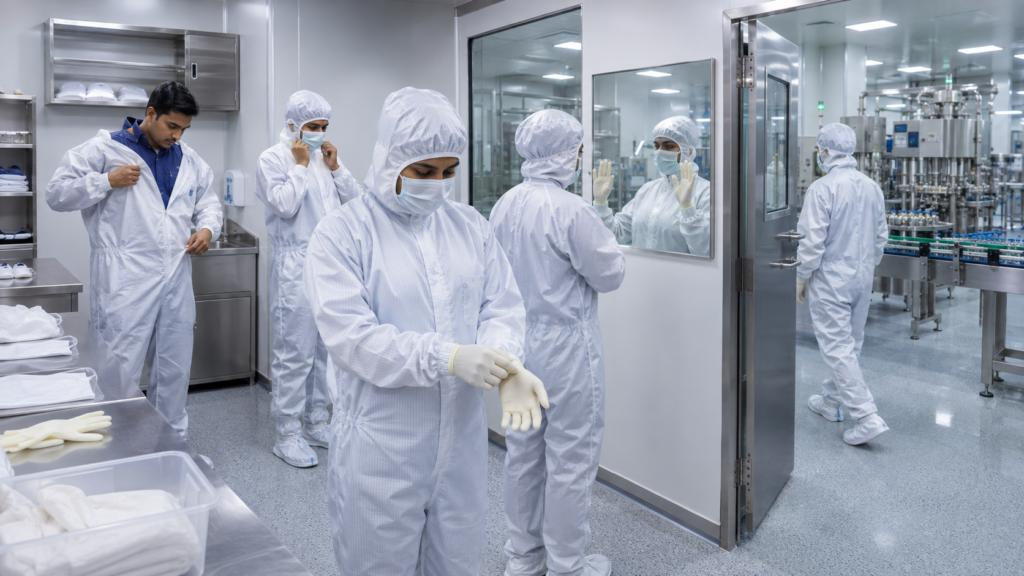
Sterile gowning is a critical part of contamination control in pharmaceutical manufacturing, particularly in facilities producing sterile medicines, injectables, vaccines and other products where microorganisms and particles can compromise product quality. In India, its importance is growing alongside a pharmaceutical industry that recorded ₹4.72 lakh crore in turnover in FY 2024–25 and pharmaceutical exports of ₹2.46 lakh crore. India is also the world’s third-largest pharmaceutical industry by volume and has the highest number of USFDA-compliant pharmaceutical manufacturing plants outside the United States.
As India’s pharmaceutical manufacturing base expands across Hyderabad, Ahmedabad, Vadodara, Ankleshwar, Baddi, Pune, Mumbai, Chennai, Visakhapatnam, Bengaluru and other clusters, sterile gowning has become more than a procedural requirement. The right cleanroom garments, sterile gowns, coveralls, hoods, masks and associated apparel form an important part of the controlled environment in which medicines are manufactured.
For pharmaceutical companies, understanding how sterile gowning works—and how garment selection affects contamination control—is increasingly important.
What Is Sterile Gowning?
Sterile gowning is the controlled process of putting on specially designed garments before entering or working in an area where sterile pharmaceutical products are manufactured.
The objective is straightforward:
Prevent personnel from introducing contamination into the controlled manufacturing environment.
People naturally shed particles, skin flakes, microorganisms and fibres. In an aseptic manufacturing area, uncontrolled personnel movement or inappropriate clothing can therefore become a contamination risk.
India’s GMP requirements recognise the particular sensitivity of sterile products. Schedule M specifies additional requirements for sterile products and parenteral preparations, including small- and large-volume injectables and sterile ophthalmic preparations. It calls for high levels of precaution and aseptic conditions and requires manufacturing areas to be appropriately separated according to their functions.
This makes sterile gowning an operational activity rather than simply putting on a uniform.
Why Sterile Gowning Matters in Pharmaceutical Manufacturing
A sterile manufacturing facility is designed around controlled conditions.
Air handling, room classification, cleaning, equipment design, personnel movement, material transfer and gowning all work together to minimise contamination risks.
Among these controls, personnel are particularly important because they move between different areas and can introduce contaminants.
A properly designed gowning system helps provide:
- Controlled coverage of the body
- Reduced shedding of particles
- Appropriate separation between personnel and the clean environment
- Consistent entry procedures
- Reduced contamination risks
- A repeatable gowning process
The garment is therefore only one component of the system. Correct gowning technique, garment handling, laundering or sterilisation, storage and personnel training are equally important.
India’s Pharmaceutical Industry Makes Sterile Gowning a Growing Requirement
India’s pharmaceutical sector is not concentrated in one city.
A Government of India study on pharmaceutical clusters identifies major manufacturing clusters across Maharashtra, Gujarat, Andhra Pradesh, Himachal Pradesh, Rajasthan, Telangana, Uttar Pradesh, Goa, Karnataka, Tamil Nadu, Haryana and Uttarakhand. Major hubs identified include Ahmedabad, Vadodara, Mumbai, Aurangabad, Pune, Hyderabad, Chennai, Mysuru, Bengaluru, Baddi, Lucknow and Visakhapatnam.
This geographic spread is important for the sterile garment industry.
Different clusters have developed strengths across formulations, APIs, vaccines, biologics, injectables, contract manufacturing, medical devices and related pharmaceutical activities.
As manufacturing becomes more specialised, the demand for cleanroom apparel and sterile gowning systems also becomes more application-specific.
Hyderabad: A Major Life Sciences and Vaccine Manufacturing Hub
Hyderabad is one of India’s most important pharmaceutical and life sciences centres.
The Telangana government describes the state as a leading life sciences and pharmaceutical manufacturing hub, with more than 2,000 life sciences companies and more than 269 USFDA-approved manufacturing facilities. It also identifies Hyderabad as the country’s Life Sciences Capital.
The ecosystem includes Genome Valley, pharmaceutical manufacturing zones, vaccine production, medical-device manufacturing and R&D facilities.
For sterile gowning, this creates demand across several environments:
- Vaccine manufacturing
- Sterile injectable production
- Biologics
- Pharmaceutical formulation
- Cell and gene therapy facilities
- Medical-device manufacturing
- R&D and testing
The development of newer integrated pharmaceutical infrastructure is also moving the industry toward larger, more technologically advanced manufacturing ecosystems. Recent industry reporting highlights Hyderabad Pharma City and Genome Valley among the country’s emerging pharmaceutical powerhouses.
In these facilities, cleanroom apparel cannot be treated as ordinary workwear. Garment design, material selection, gowning procedures and garment handling need to correspond to the controlled environment.
Gujarat: From APIs to Formulations and Injectables
Gujarat has one of India’s deepest pharmaceutical manufacturing ecosystems.
The country’s major pharma-cluster mapping includes Ahmedabad, Vadodara, Ankleshwar and Vapi among established pharmaceutical locations.
The region is particularly important for API manufacturing, chemicals, intermediates and formulations, creating a broad pharmaceutical supply chain.
North Gujarat is also expanding its pharmaceutical footprint. Recent reporting from the Gujarat government noted that the region contributes about 12% of Gujarat’s pharmaceutical manufacturing output, with Mehsana involved in bulk drugs, APIs, intermediates and formulations, while Patan has growing activity in injectables and formulations.
This diversity means sterile gowning requirements can vary significantly between facilities.
An API production area does not necessarily have the same gowning requirements as an aseptic injectable filling area.
For manufacturers of sterile gowns and cleanroom apparel, understanding that distinction is essential.
Baddi: The Pharmaceutical Manufacturing Hub of Himachal Pradesh
Baddi in Himachal Pradesh is another important pharmaceutical cluster.
The Government of India’s pharmaceutical-cluster study identifies Baddi among India’s major pharmaceutical manufacturing hubs.
The wider northern pharmaceutical belt also includes Baddi, Paonta Sahib, Haridwar, Pantnagar and the NCR region.
These manufacturing locations support large-scale formulation and pharmaceutical production, making industrial garments an important part of everyday manufacturing operations.
For facilities producing medicines at scale, sterile gowning programmes need to account for:
- Employee gowning areas
- Garment storage
- Personnel flow
- Cleanroom entry
- Garment replacement
- Laundering or sterilisation
- Controlled handling
The garment is ultimately part of a larger personnel and contamination-control system.
Maharashtra: Mumbai, Pune and Aurangabad
Maharashtra’s pharmaceutical ecosystem includes Mumbai, Pune and Aurangabad, alongside other industrial locations.
Aurangabad, for example, has a strong industrial base spanning pharmaceuticals, biotechnology and automotive manufacturing. Maharashtra’s Directorate of Industries lists pharmaceuticals and biotechnology among the area’s leading sectors.
Pune and Mumbai add further pharmaceutical, biotechnology, healthcare and research activity.
This creates demand for different categories of specialised apparel:
- Sterile gowns
- Cleanroom coveralls
- Lab coats
- Hooded garments
- Shoe covers
- Masks
- Antistatic clothing
- Protective clothing
The correct garment depends on the process and cleanroom classification rather than the geographic location alone.
Chennai: A Growing Pharmaceutical and Medical Manufacturing Base
Chennai is particularly relevant when discussing sterile gowning in South India.
Tamil Nadu’s pharmaceutical ecosystem includes manufacturing activity around Chennai, Kanchipuram and Tiruvallur, alongside other locations in the state. The Tamil Nadu Drugs Control Department maintains a current directory of licensed pharmaceutical manufacturers, including facilities in Chennai and surrounding industrial districts.
The region also includes pharmaceutical and healthcare-related industrial infrastructure such as the SIDCO Pharmaceutical Campus at Alathur, where Tamil Nadu’s government-owned TAMPCOL operates a manufacturing facility.
For Chennai’s pharmaceutical and medical manufacturing sector, sterile gowning becomes especially relevant in:
- Injectable manufacturing
- Pharmaceutical formulation
- Sterile production
- Quality-control laboratories
- Medical-device manufacturing
- Controlled research environments
The state’s regulatory infrastructure also separately provides licensing pathways for large-volume parenterals, sera and vaccines, demonstrating the regulatory importance of these product categories.
Visakhapatnam: A Strategic Pharmaceutical Cluster
Visakhapatnam, often referred to as Vizag, is another significant pharmaceutical manufacturing location.
The Government of India’s pharmaceutical cluster report identifies Visakhapatnam among the country’s major pharmaceutical manufacturing clusters.
The city’s pharmaceutical ecosystem includes the Jawaharlal Nehru Pharma City (JNPC), which has helped establish a concentrated manufacturing environment.
Such clusters are particularly relevant to cleanroom garment suppliers because shared industrial ecosystems tend to bring together multiple pharmaceutical processes, from API and intermediate production to formulations and specialised manufacturing.
Bengaluru and Mysuru: Pharmaceuticals, Biotechnology and Research
Southern India’s pharmaceutical network also extends into Bengaluru and Mysuru.
The Government of India’s cluster mapping includes both cities among India’s pharmaceutical hubs.
Bengaluru’s broader biotechnology and research ecosystem adds another dimension to the demand for specialised garments.
Here, sterile gowning can intersect with:
- Biopharmaceutical research
- Biotechnology
- Cell culture
- Laboratory operations
- Pharmaceutical R&D
- Medical technology
These environments may require combinations of cleanroom apparel, lab coats, sterile gowns and protective clothing, depending on the operation.
What Does a Sterile Gowning System Include?
Sterile gowning is not limited to a single gown.
A complete gowning system can include several garments and accessories, depending on the facility’s procedures.
Sterile Coverall or Gown
The primary garment provides controlled coverage of the worker’s body.
Hood
A hood helps cover hair, head and neck areas that can otherwise contribute to particle shedding.
Face Mask
Masks help control contamination associated with respiratory activity.
Gloves
Sterile gloves provide an additional controlled barrier between the worker and critical surfaces or products.
Shoe Covers or Dedicated Cleanroom Footwear
Footwear controls contamination associated with movement between areas.
Inner Garments
Depending on the facility, dedicated inner garments may be required before donning the outer sterile garment.
The exact configuration depends on the cleanroom, process, gowning qualification and site-specific SOPs.
Sterile Gowning Is a Process, Not Just a Garment
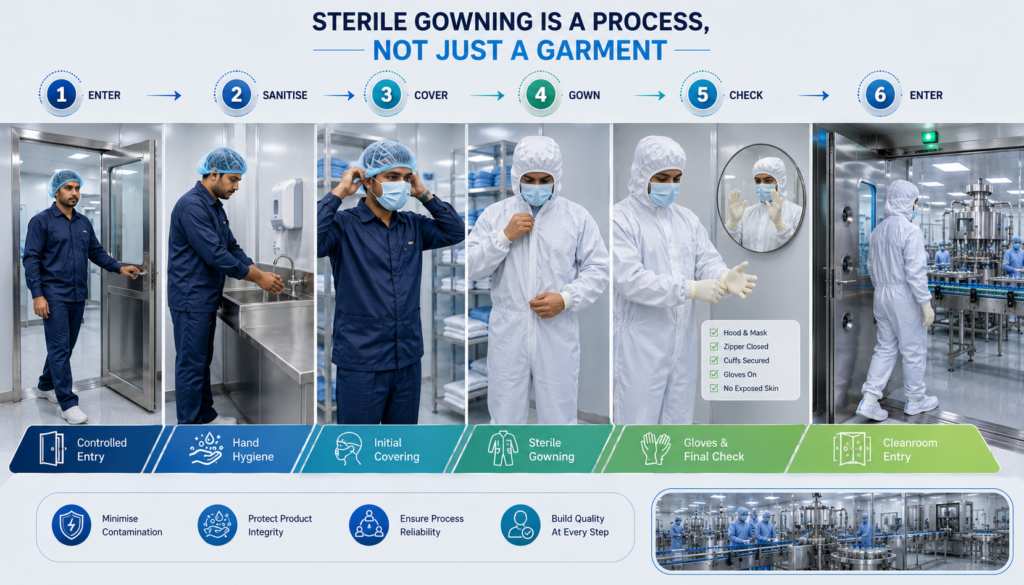
One of the most important points for pharmaceutical manufacturers is that buying sterile garments does not automatically create a sterile gowning programme.
The entire process needs to be controlled.
A typical gowning workflow may involve:
Personnel entry → Hand hygiene → First-stage garments → Controlled gowning → Sterile gloves → Final inspection → Cleanroom entry
The precise sequence varies between facilities.
The important principle is to avoid contact between potentially contaminated surfaces and the outer surfaces of the gown.
This is why personnel training and gowning qualification are essential.
Why Garment Design Matters
The design of sterile gowning apparel directly affects how easily personnel can follow the gowning procedure.
A well-designed cleanroom garment should consider: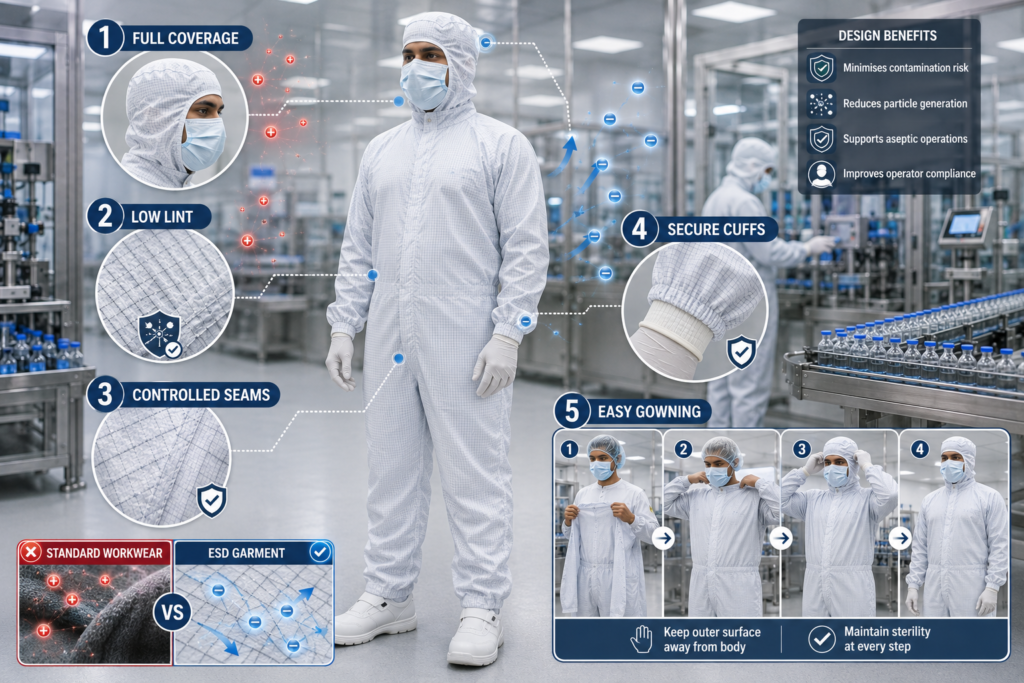
- Fabric construction
- Particle shedding
- Seam design
- Cuff construction
- Closures
- Fit
- Body coverage
- Ease of donning
- Compatibility with gloves and other PPE
- Laundering or sterilisation requirements
Poorly designed garments can make gowning unnecessarily difficult and can increase the likelihood of incorrect handling.
For pharmaceutical facilities, the garment therefore needs to be designed around the gowning process, not just around appearance.
Reusable vs Disposable Sterile Gowning
Pharmaceutical manufacturers may use reusable or disposable cleanroom garments depending on their process and contamination-control strategy.
Reusable Cleanroom Apparel
Reusable garments can be designed for controlled laundering and repeated use.
They may be appropriate for facilities with established garment-management systems.
Important considerations include: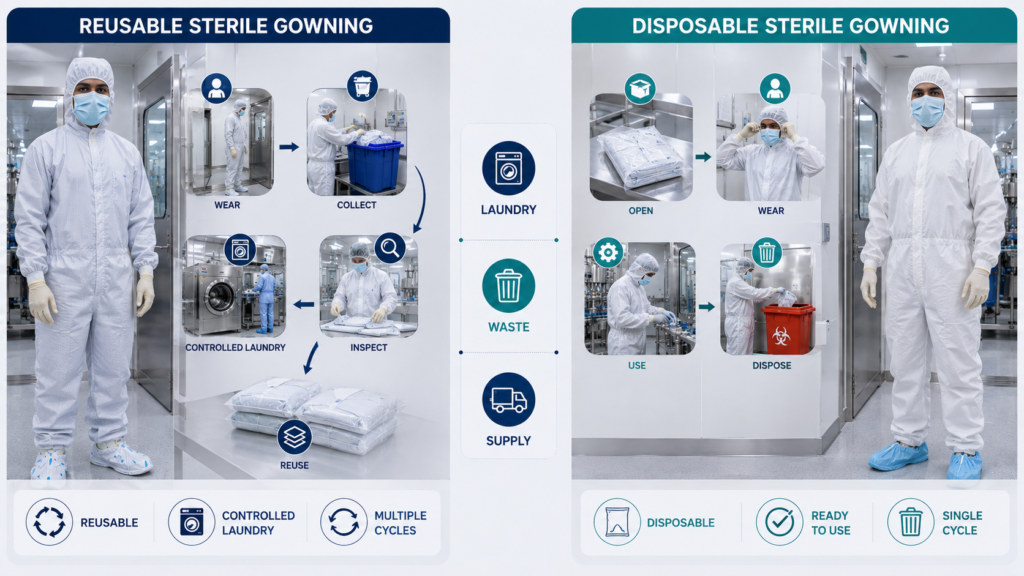
- Laundering process
- Garment integrity
- Number of washing cycles
- Storage
- Repair
- Sterilisation where required
Disposable Garments
Disposable garments can simplify certain contamination-control workflows and eliminate the need for repeated laundering.
However, they also introduce considerations around:
- Waste
- Supply continuity
- Material performance
- Packaging
- Storage
- Cost
Neither approach is automatically better.
The appropriate option depends on the facility’s risk assessment, processes and validated procedures.
Sterile Gowning in Injectable Manufacturing
Injectable manufacturing is one of the clearest examples of why sterile gowning matters.
Parenteral products are introduced directly into the body, which makes contamination control particularly important.
India’s Schedule M includes specific requirements for small-volume injectables, large-volume parenterals and sterile ophthalmic preparations and calls for strict precautions and aseptic conditions.
In an injectable facility, sterile gowning can therefore be integrated into a broader system involving:
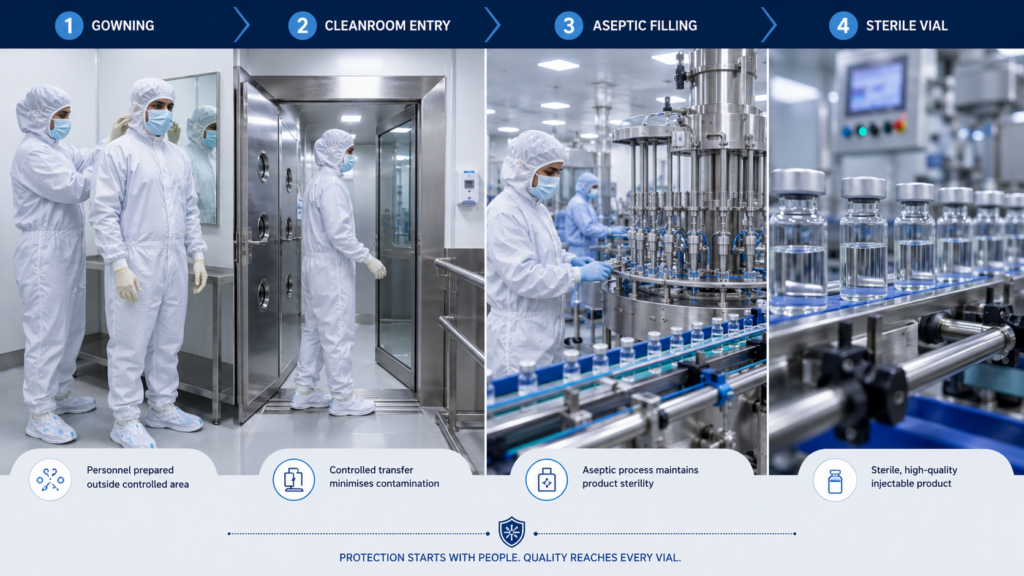
- Cleanroom zoning
- Air handling
- Personnel flow
- Material transfer
- Cleaning and disinfection
- Equipment sterilisation
- Environmental monitoring
- Aseptic processing
- Personnel qualification
The gown is one component within that system, but an important one.
The Role of Cleanroom Apparel and Sterile Gowning Beyond Pharmaceuticals
Although sterile gowning is strongly associated with pharmaceuticals, cleanroom apparel is used in other industries as well.
India’s manufacturing expansion is creating controlled environments in:
- Medical devices
- Electronics
- Semiconductor-related manufacturing
- Biotechnology
- Aerospace
- Precision engineering
- Research laboratories
The garment specification changes depending on the environment.
For example, an electronics cleanroom may require ESD garments, while a pharmaceutical facility may prioritise contamination control and sterile gowning.
Some facilities may need both.
This is why the term cleanroom garment should not be treated as a single universal product category.
ESD and Sterile Gowning Can Overlap
Modern manufacturing increasingly creates environments where multiple risks need to be controlled simultaneously.
An electronics or medical-device facility may need:
Cleanliness + particle control + electrostatic control
In such cases, an ESD-compatible cleanroom garment can be more appropriate than conventional workwear.
The garment needs to be evaluated for both its cleanroom suitability and its electrostatic properties.
This is especially relevant as India expands electronics, semiconductor and medical-device manufacturing alongside its established pharmaceutical base.
What Should Pharmaceutical Companies Look for in Sterile Gowning Apparel?
When sourcing sterile gowns or cleanroom apparel, pharmaceutical companies should look beyond the garment’s appearance.
1. Fabric Performance
The fabric should be suitable for the intended controlled environment.
2. Low Particle Shedding
Materials should be selected with the facility’s contamination-control requirements in mind.
3. Appropriate Coverage
The garment should provide the coverage required by the gowning system.
4. Controlled Construction
Seams, cuffs and closures should be designed appropriately for the intended application.
5. Sterilisation Compatibility
Where sterile garments are required, the garment and packaging system must be compatible with the validated sterilisation process.
6. Laundering
Reusable garments require controlled cleaning and garment-management procedures.
7. Traceability
For critical applications, garment identification and lifecycle management can support quality systems.
8. Consistency
Large pharmaceutical facilities need repeat orders to maintain the same garment specification across production teams.
Why India’s Pharma Clusters Create a Strong Market for Cleanroom Garments and Sterile Gowning
The geographic spread of India’s pharmaceutical industry makes sterile gowning a nationwide requirement rather than a niche need concentrated in one region.
The major clusters include:
North: Baddi, Pantnagar, Haridwar, Delhi-NCR
West: Ahmedabad, Vadodara, Ankleshwar, Vapi, Mumbai, Aurangabad, Pune, Goa
South: Hyderabad, Visakhapatnam, Bengaluru, Mysuru, Chennai, Puducherry
Central: Indore, Pithampur and Gwalior
These locations are identified across government and industry cluster studies as important pharmaceutical manufacturing ecosystems.
The Government of India’s 2026–27 manufacturing agenda is also increasingly focused on cluster-based manufacturing, including new chemical parks, pharmaceutical and biopharma infrastructure and shared manufacturing capabilities.
That means the requirement for specialised pharmaceutical apparel is likely to become increasingly connected to the development of these industrial clusters.
Sterile Gowning and India’s Next Phase of Pharmaceutical Manufacturing
India’s pharmaceutical industry is moving beyond high-volume generic production into a wider range of advanced manufacturing activities.
Biologics, vaccines, injectables, biosimilars, medical devices and contract development and manufacturing are becoming increasingly important parts of the ecosystem.
Recent industry analysis highlights the emergence of integrated clusters such as Hyderabad Pharma City, Genome Valley, Jawaharlal Nehru Pharma City and newer pharmaceutical zones in Gujarat and Himachal Pradesh.
As these ecosystems mature, pharmaceutical facilities will need increasingly sophisticated contamination-control strategies.
That makes sterile gowning an operational capability rather than simply a procurement category.
Conclusion
Sterile gowning plays a fundamental role in maintaining controlled manufacturing environments where pharmaceutical products must be protected from contamination.
India’s pharmaceutical industry—with ₹4.72 lakh crore in turnover in FY 2024–25 and ₹2.46 lakh crore in exports—has an extensive manufacturing footprint spanning Hyderabad, Gujarat, Baddi, Maharashtra, Chennai, Visakhapatnam, Bengaluru and other clusters.
As these clusters expand into injectables, vaccines, biologics, medical devices and advanced pharmaceutical manufacturing, the demand for reliable sterile gowns, cleanroom coveralls, hoods, lab coats and specialised cleanroom apparel will continue to grow.
The key is to remember that sterile gowning is not simply about wearing the right garment.
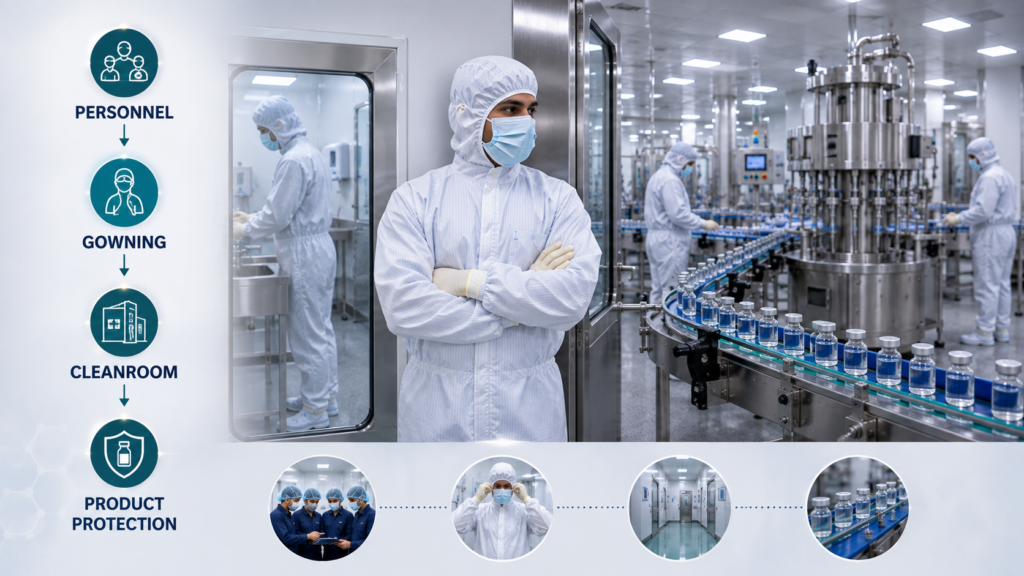
It is about creating a controlled chain from personnel entry to gowning, movement, production and exit.
For pharmaceutical manufacturers, choosing the right cleanroom apparel—and ensuring that employees are properly trained to use and maintain it—is an important part of protecting the integrity of the manufacturing environment.
Frequently Asked Questions
What is sterile gowning?
Sterile gowning is the controlled process of donning specialised garments before entering or working in an environment where sterile pharmaceutical products are manufactured.
Why is sterile gowning important?
It helps reduce the introduction of particles and microorganisms from personnel into controlled manufacturing environments.
Where is sterile gowning used in India?
It is particularly relevant to pharmaceutical facilities producing sterile injectables, vaccines, biologics and other products manufactured under controlled or aseptic conditions.
What garments are used for sterile gowning?
Depending on the facility, sterile gowning can include coveralls or gowns, hoods, masks, gloves, shoe covers and dedicated cleanroom footwear.
Is a cleanroom garment the same as a sterile gowning?
Not necessarily. Cleanroom garments are designed for controlled environments, while a sterile gowning system may require garments that are additionally processed, packaged or sterilised according to the facility’s validated procedures.
Which Indian regions have major pharmaceutical clusters?
Major pharmaceutical clusters include Hyderabad, Ahmedabad, Vadodara, Ankleshwar, Mumbai, Pune, Aurangabad, Baddi, Chennai, Bengaluru, Mysuru and Visakhapatnam.
