

Uniform for Office: How Workplace Uniforms Build Brand, Culture and Professionalism in India

Uniform for office is no longer limited to traditional corporate shirts, trousers or formal blazers. Across India, businesses are increasingly using coordinated office uniforms and professional workwear to create a consistent brand presence, improve employee identification and make day-to-day operations more organised.
India’s workplace is also becoming more service-oriented and urban. NITI Aayog’s 2025 analysis estimates that India’s services sector employed nearly 188 million people in 2023–24, making it the country’s second-largest source of employment. The report also notes that more than 60% of urban workers are employed in services.
That creates a much wider role for an office uniform. It can be relevant to employees working in corporate offices, banks, hospitals, hotels, retail stores, logistics companies, real-estate businesses, educational institutions and customer-service environments.
A well-designed uniform can bring together brand identity, employee experience, customer recognition and workplace functionality without making an organisation feel overly formal or outdated.
What Is an Office Uniform?
An office uniform is a coordinated set of garments designed for employees to wear while representing an organisation.
It could be as simple as:
- A branded formal shirt
- Formal trousers
- Polo shirt
- Blazer
- Waistcoat
- Corporate jacket
- Chinos
- Branded T-shirt
- Smart-casual workwear
The appropriate design depends on the organisation and the nature of the employee’s role.
A corporate law firm may prefer formal shirts and tailored trousers. A technology company may choose branded polos. A hotel may use a more detailed front-office uniform. A healthcare organisation may use coordinated coats, tunics or scrubs.
This is why an office uniform should be designed around the workplace rather than treated as a one-style-fits-all garment.
Why Are Office Uniforms Becoming More Relevant in India?
The modern Indian workplace is highly diverse.
A single organisation may have:
- Employees working at headquarters
- Customer-facing teams
- Sales representatives
- Front-desk personnel
- Field staff
- Facility teams
- Delivery personnel
- Technical teams
- Employees visiting client locations
A common visual identity can make these teams easier to recognise.
At the same time, businesses are paying greater attention to how their physical workforce represents the brand. Recent Indian uniform-industry discussions increasingly position corporate uniforms as a branding and employee-experience tool rather than simply a dress code.
For many organisations, therefore, an office uniform sits somewhere between corporate branding, workwear and employee experience.
1. A Uniform for Office Creates Immediate Brand Recognition
Your employees interact with customers far more frequently than your logo does.
A customer may not remember the exact colour palette from your website, but they are likely to remember the person who welcomed them, assisted them or visited their premises.
A consistent office uniform can turn that interaction into a branded experience.
Consider a bank branch.
A customer entering the branch should be able to immediately identify:
- Customer-service staff
- Relationship managers
- Security personnel
- Front-desk employees
A coordinated uniform can reduce uncertainty about who is there to assist them.
The same principle applies to retail, hospitality, healthcare and customer-service businesses, where employee visibility is part of the customer experience.
2. Uniforms Make Employees Easier to Identify
Identification is one of the most practical benefits of an office uniform.
Imagine walking into a large hospital reception area.
There may be visitors, patients, doctors, nurses, technicians, housekeeping staff and administrative employees moving through the same space.
Distinctive uniforms help people understand who does what.
The same concept works in:
- Hotels
- Airports
- Retail stores
- Corporate campuses
- Educational institutions
- Hospitals
- Logistics facilities
- Large service centres
Uniform design can even differentiate departments through colours, trims or garment styles while keeping the overall brand identity consistent.
3. Office Uniforms Strengthen Professional Appearance
Professionalism is not simply about wearing expensive clothing.
It is about consistency and appropriateness.
An employee wearing a well-fitted shirt in the company’s approved colour, paired with suitable trousers and a discreet logo, can create a more consistent appearance than a workforce following completely different interpretations of business casual.
This becomes particularly useful in organisations where employees regularly interact with customers.
For example, a real-estate company could provide its property consultants with coordinated shirts, trousers and jackets.
When employees meet prospective buyers at a property site, the uniform makes them immediately identifiable as representatives of the company.
4. A Uniform for Office Can Reduce Everyday Dress-Code Decisions
Dress codes can create unnecessary ambiguity.
One employee may consider jeans acceptable for business casual. Another may choose a polo shirt. Someone else may arrive in a formal shirt and blazer.
A company-issued office uniform removes much of that uncertainty.
Employees know what they are expected to wear.
HR teams also have a clearer framework for onboarding new employees, replacing damaged garments and maintaining appearance standards.
This does not mean every company needs a strict uniform every day.
Some organisations may use uniforms only for:
- Customer-facing days
- Monday–Thursday formal schedules
- Events
- Client visits
- Field work
- Front-office roles
The system can be adapted to the organisation’s culture.
5. Office Uniforms Can Support Workplace Equality
One often-overlooked benefit of an office uniform is that it reduces visible differences in personal clothing.
When employees arrive wearing completely different outfits, clothing can sometimes become an unintended indicator of personal spending preferences.
A common uniform creates a shared visual standard.
This can be particularly useful in large organisations where employees come from different backgrounds and work across different departments.
The objective isn’t to erase individuality.
Instead, the uniform establishes a common professional layer while employees retain their personality through communication, behaviour and performance.
6. Uniforms Build a Sense of Belonging
A uniform can also become a visual symbol of membership.
Think about employees at a large hotel preparing for a busy shift.
The front-office team, housekeeping team, restaurant staff and management may have different uniforms, but the coordinated appearance communicates that everyone belongs to the same organisation.
This can contribute to a stronger sense of team identity.
Indian organisations are increasingly considering uniforms as part of broader employee and brand experiences rather than treating them purely as mandatory clothing.
The effect is particularly visible in industries where teamwork and customer interaction are central to daily operations.
7. Uniform for Office Improve Customer Confidence
A uniform cannot guarantee good service, but it can make the service environment easier to understand.
Imagine visiting a premium diagnostic centre.
If reception staff, technicians and support employees have clearly identifiable clothing, patients can quickly determine whom to approach.
The same applies to a hotel.
A guest arriving at the lobby should not have to guess which person is a member of staff.
This is why office uniforms can be particularly valuable in customer-facing organisations.
They provide a simple visual signal:
“This person represents the organisation.”
8. Office Uniforms Turn Employees Into Brand Touchpoints
A company’s branding does not stop at its website, office signage or advertising.
Employees can carry that branding into:
- Client meetings
- Conferences
- Airports
- Retail locations
- Construction sites
- Customer homes
- Events
- Partner offices
A branded uniform therefore extends the company’s visual identity beyond its own premises.
Consider a telecom or broadband company.
A field technician wearing a clearly branded shirt while visiting a customer’s home creates a very different experience from an unidentified technician wearing ordinary clothing.
The uniform provides recognition before conversation begins.
9. Uniform for Office Can Support Different Roles Within One Organisation
A good uniform programme does not necessarily mean giving everyone identical clothing.
Instead, companies can create a uniform system.
For example:
| Role | Possible Uniform |
|---|---|
| Reception | Formal shirt + trousers |
| Sales | Shirt + trousers/blazer |
| Customer service | Branded polo |
| Field technician | Functional workwear |
| Security | Security uniform |
| Housekeeping | Practical uniform |
| Management | Formal corporate apparel |
All garments can share the same brand colours, logo treatment and visual language.
This creates consistency without ignoring the practical requirements of different jobs.
10. The Right Fabric Matters in India’s Climate
An office uniform should not be selected purely on appearance.
India’s climate makes comfort particularly important.
Employees in Chennai, Mumbai, Hyderabad, Bengaluru, Delhi or Ahmedabad can experience very different combinations of heat, humidity and seasonal conditions.
A garment that looks good in a catalogue may not perform well during an eight-hour working day.
Companies should consider:
- Breathability
- Fabric weight
- Moisture management
- Durability
- Colour retention
- Shrink resistance
- Wrinkle resistance
- Ease of washing
- Comfort during long working hours
For offices with air conditioning throughout the day, lightweight formal fabrics may work well. For employees moving between indoor and outdoor environments, a more breathable workwear fabric may be preferable.
11. Office Uniforms Can Become Functional Workwear
The distinction between an office uniform and workwear is becoming less rigid.
A facilities management employee may spend part of the day at a desk and the rest inspecting equipment.
A sales engineer may move between an office and manufacturing facility.
A property manager may alternate between reception, site visits and client meetings.
These employees need clothing that looks professional but also allows movement.
That is where corporate workwear becomes useful.
Instead of a traditional formal uniform, companies can choose:
- Stretch trousers
- Performance shirts
- Smart polo shirts
- Lightweight jackets
- Functional overshirts
- Easy-care fabrics
The result is a uniform that looks professional without restricting everyday work.
12. Uniform for Office Can Improve Operational Organisation
Uniforms can also support internal operations.
Different colours or garment styles can help employees identify departments quickly.
For example, a large hotel might use:
Navy → Front Office
White → Housekeeping
Black → Restaurant Service
Grey → Maintenance
A large hospital may similarly distinguish administrative, housekeeping and technical teams.
This can make large workplaces easier to navigate.
It is a simple visual management system that requires no technology.
13. Uniform for Office Can Support Safety in Certain Workplaces
Although office uniforms are generally associated with corporate appearance, some workplaces have mixed office-and-industrial environments.
Employees may need to move between:
Office → Warehouse → Production Area
In these situations, specialised protective clothing or industrial workwear may be required in certain zones.
For example, an engineering company’s administrative employees visiting a production floor may need:
- Safety footwear
- High-visibility clothing
- Protective jackets
- ESD garments
- Appropriate PPE
The important distinction is that a branded office uniform should never replace task-specific PPE where safety requirements apply.
14. An Office Uniform Programme Can Simplify Employee Onboarding
Uniform management can become particularly useful as companies grow.
A new employee should not have to figure out what to wear from their first day.
A structured uniform programme can provide:
- Approved garment designs
- Standard sizes
- Defined quantities
- Brand specifications
- Replacement procedures
- Care instructions
This makes the process more predictable for both HR and employees.
For companies opening new branches across India, standardised uniforms can also help maintain the same visual identity across locations.
15. Uniform for Office Create Consistency Across Multiple Branches
Consider an Indian retail chain with outlets in Delhi, Mumbai, Bengaluru and Chennai.
Customers should experience the same brand regardless of which branch they visit.
Interior design helps, but employees are often the most visible part of the physical experience.
A consistent office uniform can therefore help create continuity across locations.
This becomes even more important for businesses operating:
- Franchise networks
- Hotel chains
- Retail stores
- Hospitals
- Banks
- Educational institutions
- Service centres
Choosing an Uniform for Office for Different Indian Industries
There is no universal office uniform.
Banking and Financial Services
Formal shirts, trousers, blazers and subtle brand colours can reinforce trust and professionalism.
IT and Technology
Smart-casual polos, shirts, jackets or branded T-shirts may better suit a modern technology workplace.
Healthcare
Administrative teams may use coordinated shirts, tunics or coats, while clinical employees require specialised healthcare apparel.
Hospitality
Uniforms often need to combine appearance, comfort and role identification.
Retail
Strong brand colours and easily identifiable designs can help customers locate employees.
Real Estate
Formal or smart-casual uniforms can help sales teams appear professional during property visits.
Logistics and Field Services
Durability, visibility, comfort and practical workwear features become more important.
Manufacturing
Office personnel may require corporate apparel, while production employees require appropriate industrial workwear and protective clothing.
What Makes a Good Uniform for Office?
A successful uniform balances brand, people and practicality.
1. Brand Alignment
Colours, logo placement and styling should complement the company’s visual identity.
2. Employee Comfort
Employees may wear the garment for most of their working day. Comfort should therefore be treated as a requirement, not an optional feature.
3. Role Suitability
A receptionist and field technician should not necessarily wear the same garment.
4. Easy Maintenance
Machine-washable, colourfast and wrinkle-resistant fabrics can reduce daily maintenance.
5. Consistent Sizing
A uniform programme needs reliable sizing across different employees and repeat orders.
6. Durability
Garments should withstand the expected frequency of washing and normal workplace use.
7. Appropriate Customisation
Embroidery, printing, trims and colour combinations should reinforce the brand without making the garment look promotional.
Common Mistakes Companies Make With Uniform for Office
A uniform programme can fail even when the garments look good.
Some common mistakes include:
Choosing Appearance Over Comfort
A beautiful uniform that employees dislike wearing will eventually become a compliance problem.
Using the Same Design for Every Department
Different jobs have different functional requirements.
Ignoring India’s Climate
Heavy fabrics may be uncomfortable in hot and humid regions.
Poor Sizing
One-size-fits-all approaches rarely work for a diverse workforce.
Overbranding
Large logos and excessive brand colours can make professional clothing look more like promotional merchandise.
Ignoring Maintenance
A garment should be designed with washing, ironing, replacement and repeat procurement in mind.
Uniform for Office as Part of a Larger Brand Identity

A company’s identity is expressed through many physical touchpoints:
Logo → Office → Website → Packaging → Employee → Customer Experience
An office uniform connects several of these elements.
A well-designed uniform can use the same brand colours found on the company’s website and signage while translating them into something employees can comfortably wear.
This is particularly valuable for companies where employees are regularly visible to customers.
The uniform becomes a living part of the brand.
The Future of Uniform for Office in India
The Indian workplace is becoming more diverse, service-driven and brand-conscious.
NITI Aayog’s 2025 services-sector analysis highlights the scale of India’s services workforce and its increasingly urban employment profile.
At the same time, organisations are becoming more conscious of employee experience, comfort and how their teams appear to customers.
That means the future of the office uniform is unlikely to be about forcing every employee into the same formal shirt.
Instead, companies are likely to adopt more flexible uniform systems:
- Formal corporate wear for executives
- Smart-casual workwear for office teams
- Functional apparel for field staff
- Role-specific uniforms for customer-facing employees
- Seasonal fabrics
- Gender-inclusive sizing
- Brand-specific colour systems
- Performance fabrics
- More comfortable silhouettes
The result is a more practical approach to workplace clothing.
Conclusion
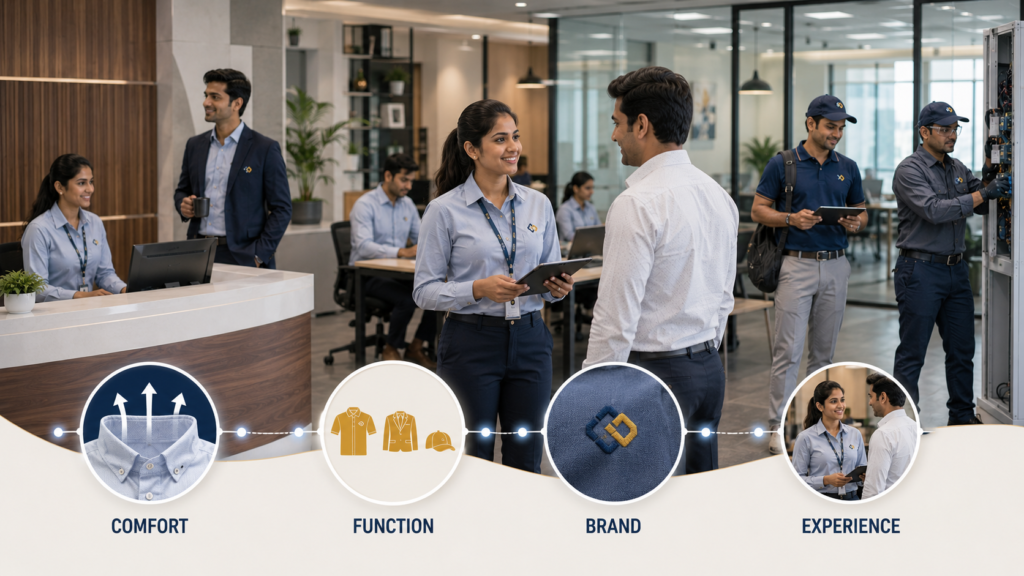
An office uniform can do much more than establish a dress code.
It can help employees become easier to identify, create consistency across branches, reinforce brand identity, simplify onboarding, support workplace organisation and provide customers with a clearer sense of who represents the company.
The benefits become particularly visible in organisations where employees interact directly with customers.
A hotel employee wearing a distinctive front-office uniform helps guests find assistance. A retail employee becomes immediately recognisable on the shop floor. A healthcare administrator can be distinguished from visitors. A real-estate consultant can present a consistent professional image at property sites. A field-service technician can carry the company’s identity directly into a customer’s home.
For businesses, the key is to avoid treating uniforms as simply “clothes everyone has to wear.”
The better approach is to design them as a combination of workwear, employee apparel and brand identity.
When comfort, functionality and visual consistency are considered together, an office uniform becomes an everyday business asset rather than just another item in the HR budget.
Frequently Asked Questions
What is an office uniform?
An office uniform is coordinated clothing provided or specified by an organisation for employees to create a consistent professional appearance and, where relevant, support identification and workplace functionality.
What are the benefits of an office uniform?
An office uniform can improve employee identification, strengthen brand recognition, create visual consistency, simplify dress-code management, support team identity and improve the professional appearance of customer-facing teams.
Should every employee wear the same uniform for office?
Not necessarily. Companies can create a common visual identity while using different garments for executives, reception staff, sales teams, field employees and technical personnel.
Which fabric is best for uniform for office in India?
The choice depends on the location, workplace and job role. Breathable, durable and easy-care fabrics are generally useful for India’s varied climate, while employees working outdoors or in industrial environments may need specialised performance workwear.
Can uniform for office be used for branding?
Yes. Brand colours, discreet logo placement, consistent garment styling and coordinated accessories can turn employee apparel into a physical extension of the company’s brand identity.
Is uniform for office suitable for customer-facing businesses?
They can be particularly useful for businesses such as retail, hospitality, healthcare, banking, real estate and field services, where employees regularly interact with customers.
