

Uniform for hospital: Types, Uses and What Modern Healthcare Facilities Need

Uniform for hospital is an important consideration for healthcare facilities that need to balance hygiene, comfort, professional appearance and the practical demands of patient care. From doctors and nurses to laboratory technicians, housekeeping teams and security staff, a hospital may require several different types of uniforms rather than one standard garment for everyone.
India’s healthcare sector is expanding across large metropolitan hospitals, specialist centres and rapidly growing Tier II and Tier III cities. As of February 2026, India had around 39.40 lakh nursing personnel, while the country had more than 800 medical colleges. The hospital segment also accounts for a substantial share of India’s healthcare market.
This expansion makes well-planned hospital apparel increasingly important.
A hospital uniform is not simply clothing. It can support role identification, workplace comfort, infection-prevention practices, professional appearance and operational efficiency when it is designed and used appropriately.
What Is a Hospital Uniform?
A hospital uniform is workwear designed specifically for employees working in healthcare environments.
Unlike ordinary office clothing, hospital uniforms need to accommodate:
- Long working hours
- Frequent movement
- Repeated laundering
- Patient contact
- Exposure to fluids or contaminants
- Different clinical environments
- Department-specific requirements
The appropriate garment also depends on the employee’s role.
A surgeon working in an operating theatre does not have the same clothing requirements as a receptionist working at the hospital entrance.
That is why modern hospitals often use a uniform system rather than one universal uniform.
Why Hospitals Need Different Types of Uniforms
A hospital is effectively a collection of different working environments.
Consider a typical multi-specialty hospital. It may contain:
- Emergency department
- Intensive care unit
- Operating theatres
- Diagnostic laboratories
- Pharmacy
- Radiology
- General wards
- Outpatient departments
- Housekeeping
- Kitchen
- Security
- Administration
Each area presents different requirements.
India’s national infection-prevention guidelines, for example, distinguish between ordinary work attire and protective equipment according to the risk of exposure. They recommend selecting PPE based on the anticipated contamination of clothing or the body with blood, body fluids, secretions or other hazards.
Therefore, choosing a uniform for hospital should begin with the employee’s role and working environment.
Types of Uniform for Hospital Environments

1. Doctor’s Coat and Clinical Wear
The traditional white coat remains strongly associated with doctors and clinical professionals.
However, hospitals increasingly use a combination of:
- Scrubs
- White coats
- Clinical shirts
- Trousers
- Department-specific apparel
A doctor moving between outpatient consultation rooms and clinical areas may need clothing that offers professional appearance while remaining practical for movement and frequent cleaning.
The important consideration is that a white coat or clinical jacket should not automatically be considered PPE. Clinical coats worn for comfort or identification are different from isolation gowns designed as protective apparel.
2. Nurse Uniforms and Scrubs
Nurses spend significant portions of their working day moving between patients, treatment areas and nursing stations.
Their uniforms therefore need to support:
- Mobility
- Comfort
- Breathability
- Easy maintenance
- Practical pocket placement
- Professional appearance
Modern nursing uniforms commonly include scrub tops and trousers, although designs vary between hospitals.
Colour coding can also help patients and visitors distinguish nursing teams from doctors, technicians and other staff.
3. Surgical Scrubs
Operating theatres require a more controlled clothing environment.
Surgical scrubs are designed specifically for clinical settings and are generally worn as part of the facility’s established infection-prevention and theatre protocols.
A surgical scrub set typically consists of:
- Scrub top
- Scrub trousers
- Appropriate head covering
- Suitable footwear
Additional PPE is selected according to the procedure and contamination risk.
Indian national IPC guidance also recommends changing personal footwear when entering clean areas such as operating theatres, labour rooms and ICUs, illustrating why hospital clothing and footwear policies need to be designed around specific environments.
4. Operating Theatre Gowns
Operating theatre gowns are different from ordinary hospital uniforms and thus may need specific customisation.
They may be designed to provide a barrier during surgical procedures where exposure to blood or body fluids is possible.
Depending on the procedure, the gown may be used alongside:
- Surgical gloves
- Masks
- Head covers
- Eye protection
- Other PPE
The exact level of protection should be determined by the hospital’s infection-control and procedure-specific protocols.
The important distinction is simple:
A uniform identifies and supports the worker; PPE provides protection against a defined hazard.
5. Lab Coats and Laboratory Apparel
Hospitals with pathology, microbiology, biochemistry or molecular diagnostic laboratories have another specialised apparel requirement.
A lab coat can provide an additional layer between the worker’s clothing and the laboratory environment.
Laboratory personnel may also require additional protective equipment depending on the substances and procedures involved.
For example, a microbiology laboratory may have very different requirements from a hospital administration office.
6. Isolation Gowns and Protective Clothing
Isolation gowns are used when there is a foreseeable risk of contamination from blood, body fluids or infectious material.
These should not be confused with ordinary staff uniforms.
The CDC notes that isolation gowns are selected according to the nature of the patient interaction and anticipated exposure to infectious material or body fluids.
In India, national IPC guidance similarly states that PPE selection should be based on the estimated contamination risk and the route of transmission.
Depending on the situation, protective clothing may be accompanied by:
- Gloves
- Masks or respirators
- Goggles
- Face shields
- Shoe covers
- Head covers
7. Housekeeping and Cleaning Staff Uniforms
Hospital housekeeping teams work in some of the most operationally demanding areas of a facility.
Their uniforms should therefore prioritise:
- Durability
- Easy washing
- Comfortable movement
- Department identification
- Practical pockets
- Appropriate protective equipment
A housekeeping uniform may look similar to ordinary workwear, but the fabric and garment construction need to withstand frequent cleaning and demanding working conditions.
8. Pharmacy Staff Uniforms
Hospital pharmacies may use a more formal uniform or lab-coat-based apparel.
The objective is often to provide clear staff identification while maintaining a clean and professional appearance.
Depending on the hospital’s policy, pharmacy personnel may wear:
- Lab coats
- Formal shirts
- Scrubs
- Branded pharmacy uniforms
9. Laboratory Technician Uniforms
Diagnostic laboratories require clothing that supports practical work and appropriate protection.
Laboratory technicians may use:
- Lab coats
- Scrubs
- Protective gowns
- Gloves
- Eye protection
The specific combination depends on the procedures and hazards present in the laboratory.
10. Patient Transport and Support Staff Uniforms
Large hospitals also employ teams responsible for moving patients, equipment and supplies.
These employees may need uniforms that prioritise:
- Mobility
- Durability
- Easy identification
- Comfort
- Easy-care fabrics
A simple colour-coded uniform can help patients and visitors quickly identify support personnel.
11. Uniform for Hospital Security
Security staff are not clinical workers, but they are an important part of the hospital environment.
Their uniforms should provide:
- Professional appearance
- Easy identification
- Comfort during long shifts
- Durability
- Practical storage
A clearly identifiable security uniform can also make it easier for patients and visitors to locate assistance.
12. Reception and Administration Uniforms
The first interaction many patients have with a hospital is at reception.
Receptionists and front-office employees therefore require a uniform that combines:
Professional appearance + comfort + brand identity
Common options include:
- Formal shirts
- Trousers
- Blazers
- Polo shirts
- Branded corporate uniforms
For private hospitals and healthcare chains, these uniforms can become part of the organisation’s wider visual identity.
Hospital Uniforms and Infection Prevention
One of the most important points to understand is that uniforms are only one part of infection prevention and control.
WHO describes infection prevention and control as an evidence-based approach covering areas such as hand hygiene, standard precautions, healthcare-associated infection prevention and safe injections.
The same principle applies to hospital apparel.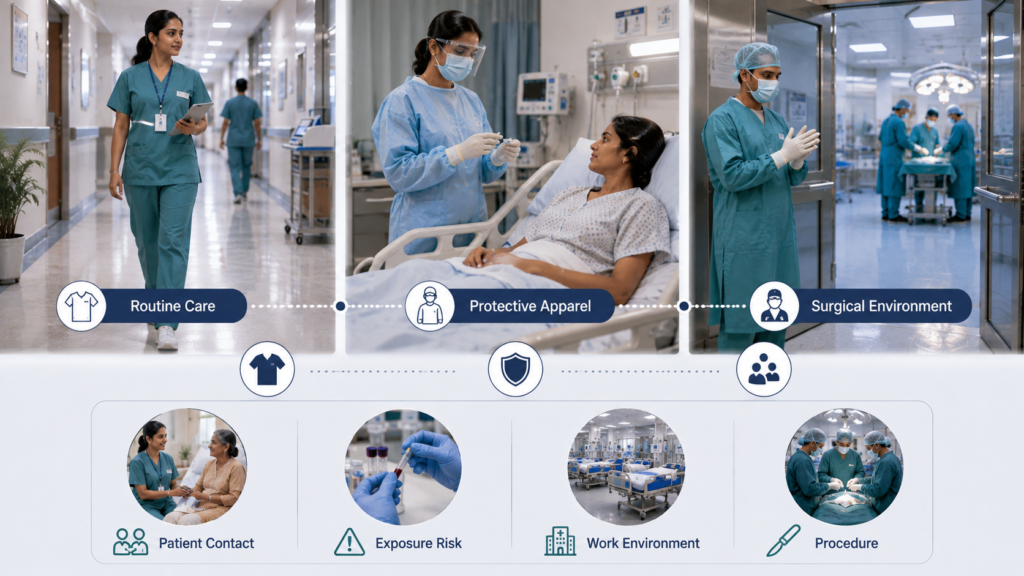
A well-designed garment does not replace:
- Hand hygiene
- Appropriate PPE
- Environmental cleaning
- Correct laundry procedures
- Safe waste management
- Engineering controls
- Staff training
India’s national IPC guidelines specifically emphasise appropriate PPE selection, training in donning and doffing, and ensuring sufficient supplies of appropriate PPE.
Fabric Selection Matters in a Uniform for Hospital
A hospital uniform can look professional and still be unsuitable if the fabric is poorly chosen.
Healthcare employees can spend eight, ten or even twelve hours wearing their workwear.
Therefore, fabric selection should consider:
Breathability
Important for employees working long shifts, especially in India’s warmer climate.
Durability
Hospital uniforms may undergo frequent washing and repeated use.
Colourfastness
Uniform colours should remain stable after repeated laundering.
Easy Care
Fabrics that are practical to wash and maintain can simplify hospital laundry operations.
Comfort
Softness, weight, stretch and garment construction all influence comfort.
Appropriate Protection
Where a specific hazard exists, the garment or PPE must meet the requirements appropriate to that hazard.
Uniform for Hospital Need to Survive Repeated Washing
Healthcare workwear is not occasional clothing.
It can be washed repeatedly throughout its service life.
That means a hospital should consider more than how a uniform looks when it is n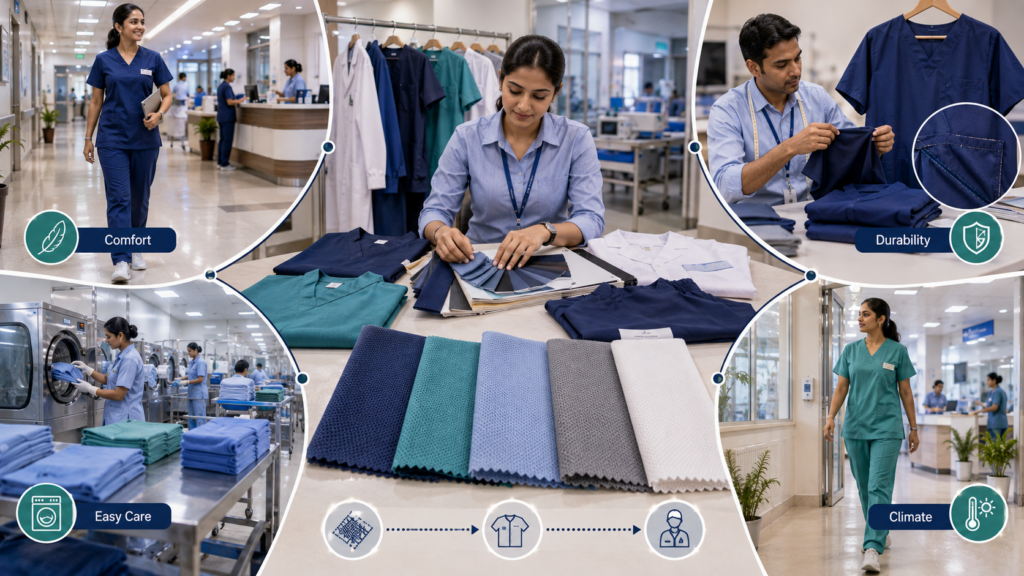 ew.
ew.
Repeated laundering can affect:
- Colour
- Fabric strength
- Shrinkage
- Seam integrity
- Shape
- Embroidery
- Fasteners
Uniform programmes should therefore include appropriate laundering and replacement policies.
Research into healthcare uniforms has found that work attire can become contaminated during clinical activity, reinforcing the importance of appropriate uniform policies and laundering practices.
Colour Coding Can Make Hospitals Easier to Navigate
Colour is not merely a design choice.
A hospital can use different uniform colours to help patients identify departments.
For example:
Blue → Nursing
White → Doctors
Green → Surgical teams
Grey → Support services
Maroon → Administration
The exact colour system will vary between hospitals.
The important point is consistency.
If every department uses a defined colour and style, patients can identify staff more easily without having to read name badges.
Uniform for Hospital Also Support Professional Identity
Healthcare workers operate in environments where trust matters.
A consistent uniform can create a sense of:
- Professionalism
- Role clarity
- Organisational identity
- Team belonging
- Patient confidence
Research discussing hospital staff uniforms describes work attire as part of professional identity as well as infection-control considerations.
For large hospital groups, this becomes even more visible.
A patient visiting one branch of a healthcare chain should ideally experience the same visual identity when visiting another.
Real-World Example: A Multi-Specialty Indian Hospital
Consider a large multi-specialty hospital in Delhi, Mumbai, Bengaluru or Chennai.
It may employ hundreds or thousands of people.
Instead of giving everyone the same uniform, the hospital could establish a structured apparel programme:
| Department | Possible Apparel |
|---|---|
| Doctors | Scrubs / clinical wear / lab coat |
| Nurses | Scrubs |
| Surgeons | Surgical scrubs and theatre apparel |
| Laboratory | Lab coat / protective apparel |
| Pharmacy | Lab coat / clinical uniform |
| Housekeeping | Durable service uniform |
| Security | Security uniform |
| Reception | Corporate uniform |
| Patient transport | Functional workwear |
| Technical maintenance | Industrial workwear |
This approach creates departmental distinction without losing overall hospital identity.
Why Uniform Standardisation Matters for Hospital Chains
India’s healthcare infrastructure is increasingly expanding beyond the largest metropolitan areas.
Demand for healthcare services in Tier II and Tier III cities is expected to remain strong, while investment in hospital infrastructure continues to expand.
For a hospital chain operating across multiple locations, standardised uniforms can make procurement easier.
A central uniform specification can define:
- Approved fabrics
- Colours
- Garment designs
- Logo placement
- Size charts
- Stitching standards
- Department coding
- Replacement schedules
This helps maintain consistency when uniforms are ordered for multiple hospitals.
What Should Hospitals Look for When Choosing a Uniform for Hospital?
Before selecting a uniform for hospital, procurement teams should consider more than appearance.
1. Role
What does the employee actually do?
2. Environment
Is the employee working in a ward, laboratory, operating theatre, reception area or outdoors?
3. Exposure
Could the employee encounter blood, body fluids, chemicals or other hazards?
4. Comfort
Will the uniform remain comfortable throughout a long shift?
5. Laundering
Can it withstand the hospital’s cleaning and laundry processes?
6. Identification
Can patients quickly understand the employee’s role?
7. Standardisation
Can the same specification be reproduced consistently?
8. Branding
Does the uniform fit the hospital’s visual identity without compromising functionality?
A Uniform for Hospital is Becoming More Functional
Healthcare apparel is moving beyond the traditional image of a white coat and plain trousers.
Modern hospital workwear increasingly needs to combine:
Comfort + functionality + hygiene + identification + professional appearance
That is particularly relevant in India, where healthcare facilities range from small hospitals and diagnostic centres to large multi-specialty institutions and rapidly expanding hospital chains.
WHO also highlights that health workers face biological, chemical, physical and ergonomic occupational risks, making occupational safety an important part of healthcare facility management.
The result is a growing need for purpose-built healthcare apparel rather than a single generic uniform.
The Future of Uniform for Hospital Environments
The modern hospital is becoming more specialised.
As hospitals expand their diagnostic, surgical, emergency, laboratory and outpatient capabilities, their apparel requirements become more diverse.
This creates opportunities for:
- Better-fitting scrubs
- More breathable fabrics
- Easy-care healthcare uniforms
- Department-specific colour systems
- Functional pockets
- Technical protective clothing
- Cleanroom and controlled-environment apparel
- Better sizing across diverse workforces
- More sustainable textile choices
At the same time, uniform decisions need to remain grounded in infection prevention and occupational safety rather than fashion alone.
Conclusion
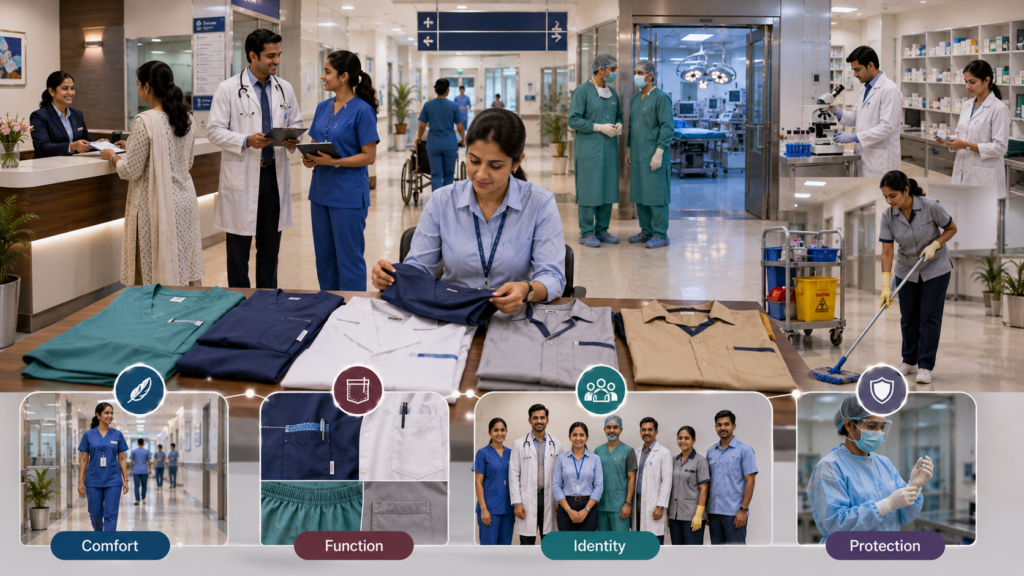
Choosing the right uniform for hospital is ultimately about matching the garment to the job.
A doctor, nurse, surgeon, laboratory technician, pharmacist, receptionist, housekeeper and security officer may all work under the same hospital roof, but their clothing requirements are very different.
A well-planned hospital uniform programme can therefore combine professional identity, comfort, durability, role recognition and appropriate protective apparel.
For Indian healthcare facilities, this is particularly relevant as the sector continues to expand across metropolitan and smaller cities. The country’s growing healthcare workforce and expanding hospital infrastructure are creating a larger need for practical, scalable and professionally designed healthcare apparel.
The goal should not be to find one uniform that fits everyone.
It should be to create a coordinated apparel system where every garment has a clear purpose.
Frequently Asked Questions
What is the best uniform for hospital staff?
There is no single best uniform for every hospital employee. Scrubs, lab coats, corporate uniforms, surgical apparel, housekeeping uniforms and protective clothing may all be required depending on the role and environment.
What should uniform for hospital be made of?
The fabric should be selected according to comfort, durability, laundering requirements, climate and the employee’s working environment. Where protection is required, the garment should meet the appropriate specifications for the identified hazard.
Are hospital scrubs considered PPE?
Not automatically. Scrubs are generally work attire. PPE such as isolation gowns is selected when there is a specific exposure risk.
Why do hospitals use different uniform colours?
Colour coding can help distinguish departments and roles, making it easier for patients and visitors to identify staff.
What is the difference between a uniform for hospital and protective clothing?
A hospital uniform primarily supports professional identification, comfort and workplace functionality. Protective clothing or PPE is selected specifically to reduce exposure to identified hazards.