

Housekeeping Uniform: More Than a Dress Code for the People Who Keep Workplaces Running
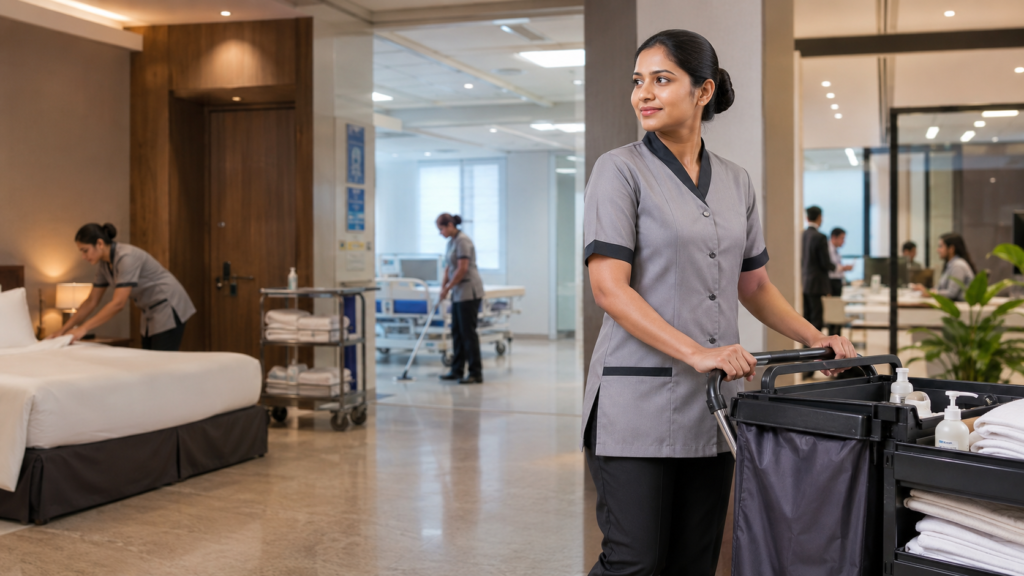
Housekeeping Uniform is often treated as one of the simplest categories of workplace clothing. In reality, the people wearing it frequently perform some of the most physically demanding, visible and operationally important work within an organisation.
From a hotel attendant preparing a guest room to a hospital housekeeping team maintaining patient areas, or a facility-management worker cleaning a pharmaceutical site, housekeeping professionals work across very different environments. Their uniform therefore has to do more than create a neat appearance.
It needs to support movement, identification, durability, hygiene practices and the practical realities of the job.
A well-designed housekeeping uniform is not simply about making a team look organised. It can become part of how efficiently people move through their workday and how confidently customers, visitors and other employees perceive the organisation.
Why Is a Housekeeping Uniform More Important Than It Looks?
Housekeeping is a highly visible function.
A guest walking through a hotel lobby may see a housekeeping employee before entering their room. A patient may encounter a cleaning team while moving through a hospital. Employees in a large corporate facility may interact with housekeeping personnel every day.
This creates an unusual combination of responsibilities.
Housekeeping staff often need to be:
- Easily identifiable
- Ready for physical activity
- Comfortable throughout long shifts
- Appropriately dressed for the environment
- Presentable in customer-facing areas
That means a housekeeping uniform sits at the intersection of function, professional appearance and workplace operations.
The best design starts with a simple question:
What does the employee actually need to do while wearing it?
That question can lead to very different answers depending on the workplace.
Housekeeping Uniform Is Not the Same in Every Industry
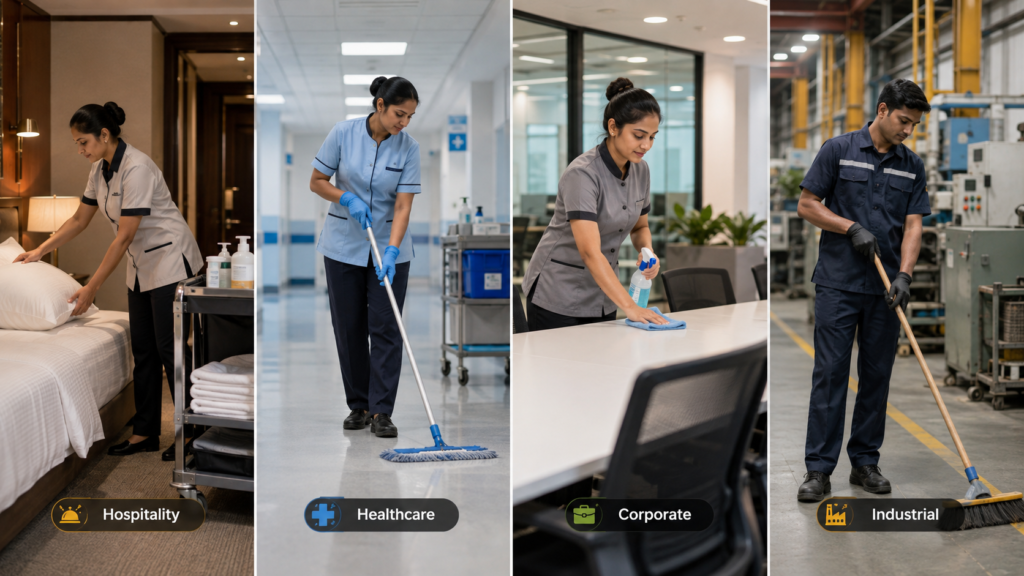
One of the biggest mistakes organisations make is treating all housekeeping work as identical.
A housekeeping employee in a five-star hotel, for example, may spend significant time in guest-facing areas. Their uniform may need to reflect the visual standards of the property.
A facility-management worker, on the other hand, may spend the day carrying equipment, moving between buildings and performing physically demanding cleaning tasks.
A healthcare environment introduces another set of considerations involving institutional hygiene policies and the need for appropriate role-based apparel.
This is why a single generic garment rarely works equally well everywhere.
Hotels and Hospitality
In hospitality, a housekeeping uniform contributes directly to the guest experience.
Guests may never know the name of the person who prepared their room, but they notice details such as cleanliness, order and professionalism.
A coordinated housekeeping team can visually reinforce the same standards.
Hotel housekeeping uniforms commonly prioritise:
- A professional appearance
- Comfortable movement
- Easy-care fabrics
- Durability
- Practical designs
- Alignment with the hotel’s visual identity
The uniform should look polished without making physically demanding work more difficult.
Hospitals and Healthcare Facilities
Hospital housekeeping teams work in a very different environment.
They may move through corridors, patient areas, waiting spaces and other designated parts of a healthcare facility throughout the day.
Their clothing requirements should be considered alongside the facility’s operational and infection-control policies.
A practical housekeeping uniform in a hospital may prioritise:
- Comfortable movement
- Easy identification
- Durability
- Frequent laundering suitability
- Role-appropriate design
It is also important to distinguish between an ordinary work uniform and protective apparel.
A housekeeping uniform does not automatically replace PPE. Where specific hazards or exposure risks exist, additional protective equipment should be selected according to the task and the facility’s procedures.
This distinction is particularly important in modern healthcare environments, where the garment system needs to match the actual work being performed.
Corporate Offices and Commercial Facilities
The housekeeping team in a large office campus may work largely behind the scenes, but its contribution is experienced by everyone using the facility.
Clean meeting rooms, organised common areas and maintained washrooms do not happen automatically.
A dedicated housekeeping uniform makes staff easier to identify when employees or visitors need assistance.
For corporate facilities, the design can balance:
Professional appearance + daily comfort + practical functionality
A smart shirt and trouser combination may work well in front-facing areas, while a more functional garment may be appropriate for employees performing physically intensive tasks.
Industrial and Manufacturing Facilities
Industrial environments can place greater demands on a housekeeping uniform.
The employee may need to:
- Walk long distances
- Move around equipment
- Work in different sections of a facility
- Handle cleaning tools
- Perform repetitive physical activities
The garment should therefore be evaluated for its suitability for the workplace rather than simply its appearance.
Factors such as fit, mobility, fabric durability and maintenance requirements become especially important.
In certain controlled manufacturing environments, ordinary housekeeping clothing may also not be appropriate. Pharmaceutical production areas, cleanrooms and other controlled spaces can require specialised garments designed around site-specific procedures.
That is where the difference between general workwear and specialised industrial apparel becomes important.
A Housekeeping Uniform Can Improve Workplace Identification
Imagine entering a large facility and needing help.
You see several people moving through the same corridor, but you cannot immediately tell who belongs to which team.
A coordinated uniform can reduce that uncertainty.
Clear role identification can be useful in:
- Hotels
- Hospitals
- Airports
- Shopping centres
- Corporate campuses
- Educational institutions
- Residential complexes
- Industrial facilities
The purpose does not have to be limited to branding.
A visually distinct housekeeping uniform can make it easier for people to find the right employee when they need assistance or need to report an issue.
This is particularly valuable in large facilities where hundreds or even thousands of people may be present every day.
Comfort Is an Operational Requirement, Not a Luxury
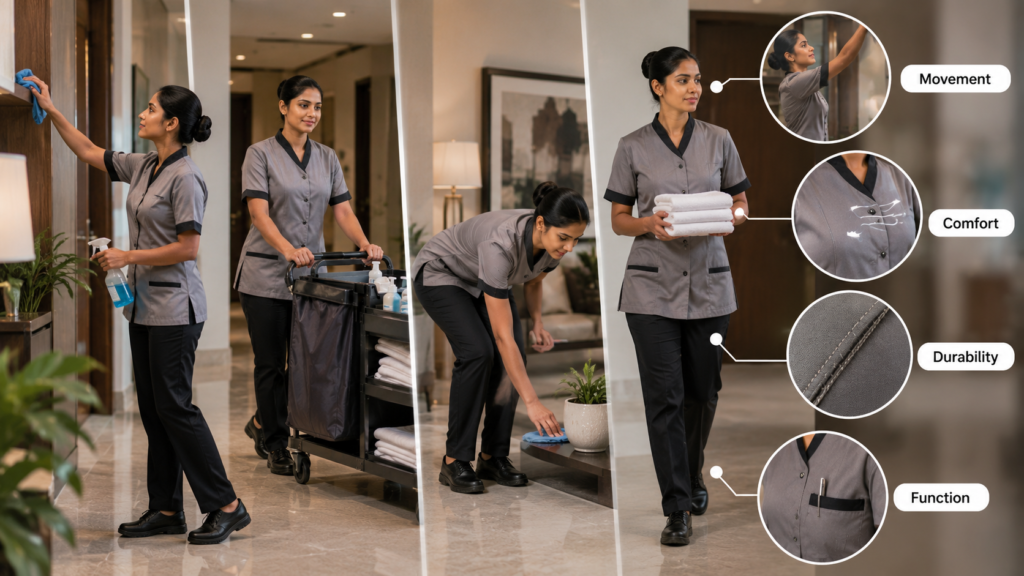
Housekeeping work is active work.
Employees may bend, walk, lift, reach, push carts and move continuously throughout a shift.
A restrictive uniform can therefore become an operational problem.
Common considerations include:
Freedom of Movement
The cut of the garment should support routine physical activity.
A uniform that looks professional while restricting bending, reaching or walking is poorly matched to the job.
Breathability
Workplace temperature matters.
Employees working long shifts in warm environments may benefit from fabrics selected with day-to-day comfort in mind.
Appropriate Fit
Uniform programmes should account for different body types and provide suitable size ranges.
Poor fit can affect both appearance and mobility.
Fabric Weight
The heaviest fabric is not automatically the most durable choice.
The garment should balance durability with the comfort requirements of the actual workplace.
For a housekeeping team, comfort is not simply an employee-perk discussion. A garment that employees can comfortably wear throughout the day is better aligned with the reality of the work.
Durability Matters Because Housekeeping Workwear Works Hard
Housekeeping uniforms often face more demanding use than ordinary office clothing.
They may go through frequent washing and repeated physical use.
A procurement decision should therefore consider how the garment performs over time.
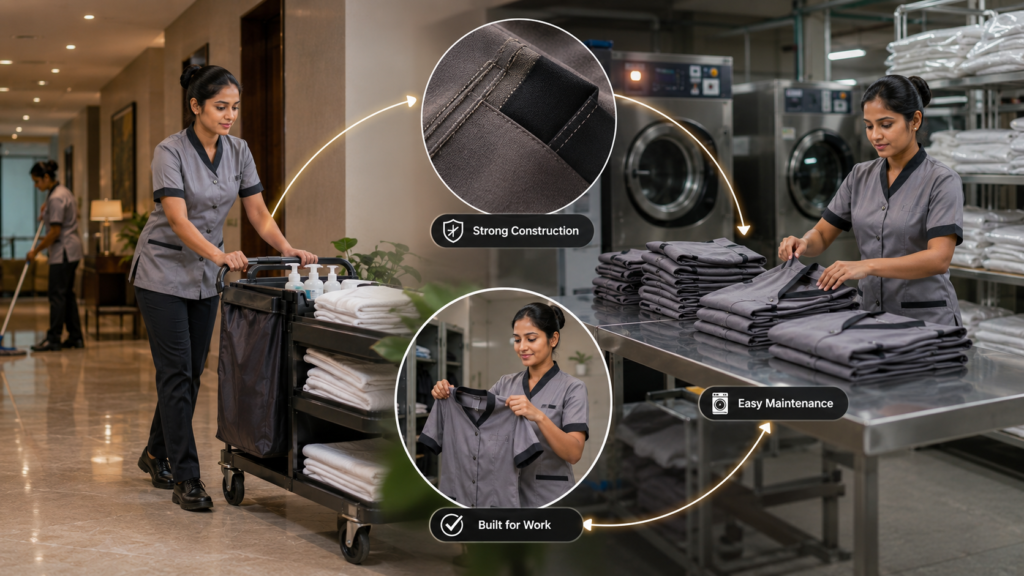
Important factors can include:
- Fabric strength
- Stitch quality
- Seam construction
- Colour retention
- Shrinkage behaviour
- Pocket durability
- Shape retention
- Performance after repeated laundering
A low initial purchase price can become less attractive if uniforms need to be replaced frequently.
This is why organisations should think in terms of the working life of the garment, not just its appearance on the day it is delivered.
The Practical Details of a Good Housekeeping Uniform
The smallest design details can have a major impact on usability.
Pockets
A well-placed pocket may help an employee carry small work-related items without affecting mobility.
However, unnecessary pockets can also add bulk or become impractical in certain environments.
The requirement should come from the role.
Easy-Care Construction
Housekeeping uniforms are often part of a repeated wash-and-wear cycle.
A practical design should take regular maintenance into account.
Colour Selection
Colour can influence:
- Department identification
- Brand consistency
- Perceived cleanliness
- Maintenance practicality
A hotel may prefer a refined colour palette that complements its interiors.
A large facility-management organisation may use colours to identify teams.
The best choice depends on the workplace rather than fashion trends alone.
Customisation
Customised elements may include:
- Company logo
- Embroidery
- Department name
- Colour coding
- Garment style
- Different fits
- Role-specific variations
Corlink’s approach to industrial garments reflects this broader principle: workplace clothing should be customised around the client’s requirements, including sizing, colours and styles.
Housekeeping Uniform and Brand Perception
Housekeeping is sometimes considered a back-office function.
In reality, housekeeping employees are often highly visible representatives of an organisation.
Consider a luxury hotel.
A guest may form an opinion about the property based on the condition of common areas, but also through everyday interactions with employees.
A professional, coordinated housekeeping uniform can reinforce the perception that the team belongs to an organised operation.
The same applies to:
- Hospitals
- Corporate offices
- Educational institutions
- Retail facilities
- Residential communities
A uniform communicates association.
It tells the public:
This person is part of the organisation.
That creates a direct connection between the employee’s appearance and the workplace’s broader visual identity.
The Overlooked Benefit: Housekeeping Uniforms Can Support Team Structure
Uniforms are also organisational tools.
In a large facility, several service teams may work simultaneously:
- Housekeeping
- Maintenance
- Security
- Gardening
- Technical services
- Food service
Distinct but coordinated workwear can help separate these functions without making the overall workplace look visually disconnected.
For example, an organisation might create a shared colour system while using different trims, shirt styles or identifiers for each department.
The result is not simply a group of employees wearing clothes with a logo.
It becomes a visual operating system for the workplace.
People can understand roles more quickly.
Teams become easier to identify.
Managers can create greater consistency across multiple locations.
One Uniform Design May Not Work Across Every Shift
Housekeeping requirements can also change depending on when and where employees work.
A morning hotel shift may have significant guest interaction.
An overnight facility-cleaning team may operate in a very different environment.
Outdoor housekeeping and maintenance personnel may face changing weather conditions.
This means businesses may need to consider:
- Seasonal variations
- Shift patterns
- Indoor versus outdoor work
- Customer-facing responsibilities
- Physical workload
Instead of ordering one standard garment for every situation, organisations can build a flexible housekeeping uniform programme.
The objective is consistency without ignoring real-world differences.
Housekeeping Uniforms in Controlled Environments
The requirements become more specialised when housekeeping activities take place in controlled environments.
For example, pharmaceutical, laboratory and cleanroom operations may have specific gowning or contamination-control procedures.
In these environments, the choice of apparel should be based on the area’s requirements rather than ordinary housekeeping conventions.
Depending on the site, specialised garments may involve:
- Low-linting materials
- Controlled garment designs
- Specific changing procedures
- Dedicated footwear requirements
- Other site-specific apparel controls
This is an important distinction for organisations that operate across both general facilities and controlled production areas.
The same employee may perform a housekeeping role, but the environment can fundamentally change the type of apparel required.
Corlink’s product range and industry focus reflect this distinction between general workplace garments and specialised apparel for industrial and controlled environments.
Sustainability of a Hpusekeeping Uniform Starts With Garments That Last
Sustainability in workplace clothing is often discussed only in terms of fabric.
But durability is also part of the conversation.
A uniform that fails prematurely may require:
- Earlier replacement
- Additional production
- More transportation
- More discarded material
A longer-lasting garment can therefore reduce unnecessary replacement cycles.
The practical approach is to select the right fabric and construction for the actual workload.
A housekeeping uniform should not be designed to be unnecessarily heavy or over-engineered.
It should be durable enough for the work it is expected to perform.
That balance matters.
How Should Businesses Choose a Housekeeping Uniform?
Before finalising a uniform design, organisations should evaluate the actual job.
A useful checklist includes:
1. Where will employees work?
Hotel rooms, hospital corridors, office buildings and industrial facilities create different requirements.
2. How physically demanding is the role?
Consider walking, bending, lifting and repetitive movement.
3. How often will the garment be washed?
Frequent laundering affects fabric and construction requirements.
4. Is the employee customer-facing?
If yes, appearance and brand presentation may have greater importance.
5. Are there specialised environmental requirements?
Controlled areas may require specific apparel beyond general housekeeping workwear.
6. What needs to be carried?
Pockets and other functional features should be based on actual needs.
7. Will the same design be used across multiple locations?
Standardisation becomes more important for organisations with several facilities.
8. Has the uniform been tested by the people who will wear it?
This may be the most valuable question of all.
A sample that looks excellent in a meeting room may perform very differently during an eight-hour shift.
The Future of Housekeeping Uniform Design
The future is unlikely to be about making housekeeping teams look more fashionable.
The more meaningful shift is toward better role-based design.
Organisations are increasingly recognising that different employees have different requirements.
A housekeeping uniform can therefore become more thoughtful in areas such as:
- Employee comfort
- Inclusive sizing
- Role-specific functionality
- Easy maintenance
- Department identification
- Durable construction
- Custom branding
- Environment-specific apparel
This represents a move away from the traditional approach of selecting a standard shirt and trouser simply because “that is what housekeeping staff wear.”
The better approach asks:
What does this team need in order to do its job comfortably and professionally?
Conclusion
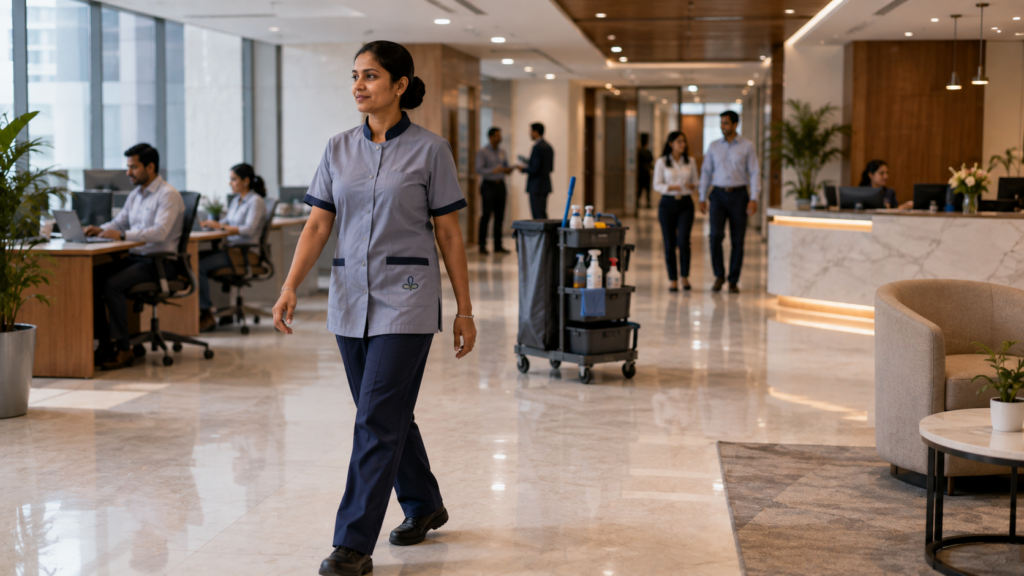
Housekeeping Uniform is far more than a way to make a cleaning team look coordinated.
It supports a complex combination of workplace needs: identification, comfort, durability, professional appearance, team structure and role-specific functionality.
A hotel attendant, hospital housekeeping worker, office facility employee and industrial cleaning professional may share the same broad job category, but their working environments can be completely different.
That is why the best housekeeping uniform is not necessarily the most fashionable or the most heavily branded.
It is the one designed around the work, environment and people who wear it.
For modern organisations, the most effective approach is to see workplace apparel as part of a larger operational system.
When a uniform combines comfortable construction, practical functionality, appropriate durability and a consistent professional identity, it becomes more than a dress code.
It becomes part of how the workplace works.
Frequently Asked Questions
What should a housekeeping uniform include?
A housekeeping uniform may include a shirt or tunic and trousers, with the exact design depending on the industry, work environment and employer requirements. Practical features such as appropriate pockets, comfortable construction and easy-care fabrics may also be considered.
What fabric is suitable for a housekeeping uniform?
The best fabric depends on the workplace, climate, physical demands and laundering requirements. Organisations should balance comfort, durability and maintenance needs rather than selecting fabric based only on initial appearance.
Why do hotels use housekeeping uniform?
Housekeeping uniforms can help hotels create a professional appearance, make employees easier for guests to identify and maintain a consistent visual identity across the property.
Is a housekeeping uniform considered PPE?
Not necessarily. A work uniform and personal protective equipment serve different purposes. Where a specific task creates an exposure risk, additional protective equipment may be required according to the workplace’s safety procedures.
Can a housekeeping uniform be customised?
Yes. Depending on the organisation, uniforms can be customised through colours, logo placement, embroidery, sizing, garment styles and department-specific variations.
How should businesses choose a housekeeping uniform supplier?
Businesses should evaluate the supplier’s ability to understand the work environment, maintain consistent quality, offer suitable customisation and provide garments appropriate for the intended use. Testing samples with actual employees before a large order can also help identify practical issues.
